Saturday, May 17, 2008

Keith's Birthday Card


I used another one of my little watercolor collages to make my brother's birthday card. The three kids sitting on a washtub eating watermelon are me, Keith, and our sister Carolyn (who died of breast cancer in 2001.)

Keith is looking forward to the birth of his first grandson in June. He already has two little granddaughters that he's crazy about. He even volunteered to stay home from some car race to babysit Claire.

Skylark


This is one of the little watercolor collages that I made in a class with Sherri Kiesel when she came to Houston the first weekend in March. I absolutely loved this class. I would take from her again in a minute.

"Trail of Secrets" by Eileen Goudge


The background for this spread was red and blue acrylic paints washed with Vintage White. The title was written with a dark gray Pitt brush pen and the text with a Pilot P-700. The magazine illustration was adhered with a xyron.

This book kept me up until the wee hours, as I couldn't turn out the light until I saw how it ended. If one is willing to suspend belief in coincidences, it's a romantic, satisfying love story.

Ellie was a teenage unwed mother whose baby was stolen from her. 22 years later, she's a successful psychologist, but her heart had been broken when she lost Bethanne, and never having been able to have another child, she is desperate to adopt. Two girls have promised her their babies, but changed their minds at the last minute.

Enter Skyler, a young equestrienne whose adoptive parents dote on her, but are unhappy with her decision to give up her baby. The pregnancy was the result of an "afternoon delight" with Tony, a NYC mounted policeman. They are drawn to each other like metal to a magnet, but coming from completely different backgrounds, believe that marriage is out of the question.

It's no mystery to the reader that Skyler is the missing Bethanne. The book revealed that fact in the first chapter. However, neither Ellie nor Skyler is aware of this, and so papers are signed when the baby is born and Ellie blissfully takes her home.

What kept me turning the pages was wanting to know how and when the book's characters would be let in on the secret, what would be their reactions, and how would they resolve the issue of custody after Skyler predictably and inevitably wants her infant back.

Monday, October 29, 2007

Reading Journal: "North River"


I loved this book. Pete Hamill is a master of his craft. His stories evoke such a realistic feeling of bygone eras that you feel like you're there, but he always slips in a bit of magic, too, in letting you into the minds of his characters.

This book is set in the New York of 1934 in the depths of the Depression. Dr. Delaney tends his patients as best he can while wondering whether his vanished wife is alive or dead. He is shocked one day to find his 3-year-old grandson Carlito on his doorstep. He hires Rose, a tough young Sicilian immigrant to cook and tend the child. Slowly, as these three lonely people form a household, the numbness around Delaney's heart starts to melt.

As in"Snow in August," the decent people have to cope with criminal elements that are a constant menace. But, thankfully, this story had a happy ending. One of the most beautiful scenes was in the next to last chapter when they go dancing.

"The lights were muted. The band was playing 'You Made Me Love You.' He put his right hand on her waist and took her right hand in his left, and they began to move. A fox trot. He could feel her tension, her fear of clumsiness. Then as she relaxed, she pressed against him. Here for a few hours, they could believe that they would be together forever. And so they danced and danced."

The paints I used for the background were Apple Barrel's "Wild Berry", "Denim Blue" and Anita's "Sand." I wrote the title and author with a Hunt 22 nib and Best Bottle ink. The ink did not work as well on the acrylic painted background as gouache. It tended to blob, as you can see in the dot over the "i" and in the loops of the "b" and "l". The text was written with a Pilot P-700.

I brushed the magazine photo with matte medium to reduce the shine, adhered it with double-stick tape, and dabbed the torn edges with Colorbox ink.

Saturday, October 06, 2007

"Woman in Red"


What an intriguing story! Set in two different time periods on a small island off the coast of Washington, it begins with the present day as Alice has just been released from 9 years in prison. She was found guilty of crippling the man who hid and killed her child while driving drunk. He got away with it because he basically owned the whole island. Rebuffed by most of her neighbors and even her remaining son, she gradually becomes friends with Colin, a recovering alcoholic who hit bottom after his wife died on 9/11. As they get to know each other, they come to realize that her grandmother was "the woman in red" in his grandfather's most famous painting. (I couldn't help being reminded of Andrew Wyeth and his Helga paintings.) At this point, the author switches to 1943 and begins to tell the forbidden love story of William and Eleanor, interspersing it with the modern-day troubles of their grandchildren. This bare bones description doesn't do justice to the plot, or the characters. It was a page-turner and had a wonderful surprise ending.

This is another one of those rather "ugly" backgrounds that I've learned to trust will be just what I need for a particular book. See how the text page resembles sand and water. I could not have purposely created that. I would have tried too hard.

I frequently use matte medium as a glue. I like that it doesn't show if any oozes out. And I often use it on top of a picture when I want to reduce the glossiness. It works great when the picture is not too big, but I've had problems with wrinkles and air bubbles when it covers a whole page. So I tried a new technique this time and liked the results. I laid the picture on some wax paper and brushed the top with matte medium to counteract the shine. After it was dry, I applied double-sided tape on the back, just along the edge that would be next to the gutter. Then I put tape on 3 edges of the journal page and carefully rolled the picture down onto the page. I had purposely not cut the picture to size because I can never completely match it to the edges of the journal page. It's just easier to trim after it's stuck in place.

"Songs of the Humpback Whale"


This was a most unusual book. It is the same story told from the viewpoint of five different characters. In many cases, the exact scene is repeated at scattered places throughout--and to complicate matters, the mother tells the story in a normal, forward-moving manner, but the daughter relates everything chronologically backwards. So while Jane tells what happened on July 3 in the front of the book, daughter Rebecca is relating what happened on August 2. This is the pattern followed throughout, so by the end of the book, Mom is telling about the events that took place on August 2 and Rebecca has completed the circle and made it back to July 3. It was somewhat disorienting, to say the least.

Basically, Jane has left her husband and with Rebecca is driving in a meandering way across country from San Diego to her brother who works in an apple orchard outside of Boston. Once there, they fall for a couple of 25-year-olds...one way too old for Rebecca, and the other a bit on the young side for Mom...never mind the fact that she's still married!

This book definitely did not have a happily-ever-after ending. Jodi Picoult is a wonderful writer and I've enjoyed the other books that I've read by her, but wasn't crazy about this one. It felt like an experiment for a writing class.

The background paint used was Anita's brand, 'Emerald' thinly brushed with 'Nubby Linen'. The title strip was art paper with botanical inclusions which I wrote on with Schmincke burnt sienna gouache with a #6 Mitchell nib. The author's name was written with a brown Micron .005 pen. I cut the strip with some wavy scissors and brushed the edges with a Colorbox "Bisque" fluidchalk inkpad.

"The Sonnet Lover"


When Robin Weiss falls to his death in NYC, one is led to believe that it was suicide, but then suspicion falls on Orlando. The story continues at a villa outside Florence where Rose Asher has been persuaded to spend the summer searching for some sonnets that Robin had supposedly found and that he believed to have been written by Shakespeare's Dark Lady. Things are complicated by Rose's current lover who is the president of the college where she teaches, and her lover from 20 years ago who also happens to be Orlando's father. I'd give this book a grade of B-minus. Not a bad summer read, but not one I found particularly engaging.

For this illustration, I used a paper napkin. Directions for doing this can be seen in the August 2005 archives "Consider the Lilies."

I got a bit too heavy-handed and tore it, but it really doesn't matter. That's one of the blessings that I've received from working in these composition journals. All my life I've been both blessed and cursed with perfectionism. It made me a hard worker and a valued employee, but it often stymied my creative efforts. In the last few years, I've learned to loosen up a bit and just embrace whatever happens. Life is messy and it's okay.

"Hardscrabble Road"


 This book consists almost completely of conversations and interior monologues. There is very little action, although the plot is convoluted and simple at the same time. The best part of the book for me was the things people had to say about the state of the modern world, and I think the author was balanced in her depiction of liberals and conservatives, or as she had one character say, "The older I get, the more I think the distinctions are wrong. Left and right. Conservative and liberal. It's not that. It's libertarian and authoritarian. It's people who want freedom and people who want control."

The characters are interesting and colorful. They include a Benedictine nun who's also a lawyer, a two-time Nobel winner, a Rush Limbaugh type, a young man who works with the homeless, and Gregor Demarkian a retired FBI agent who's called the Armenian-American Hercule Poirot.


"True Evil" by Greg Iles


Many books bill themselves as page-turners and swear you won't be able to put it down. This one lives up to that promise. A mad scientist and a greedy lawyer team up to get rid of inconvenient spouses for wealthy clients, making them die from seemingly natural causes--for very hefty fees! Alexandra Morse is a special agent whose sister alerted her to this scheme while on her deathbed.

With relentlessness, Alex began to unravel the truth by investigating clients of the divorce attorney that her brother-in-law had consulted. She soon discovered that an unusual number of them were now widowed. The book progresses with breathtaking speed as Alex matches wits with the evil doctor who appears to anticipate her every move. Her own life is almost snuffed out several times before the dramatic and satisfying end to this modern Southern gothic tale.

The cover of this book showed a snake coiled in the middle of a bed. Very apropos to the story, but since I'm deathly afraid of snakes and don't even like to look at pictures of them, I sure didn't intend to put one in my journal! Besides, I try to come up with my own idea to illustrate a book. Thus, the scientist manipulating a virus and the poor little lab monkey.

"We Shall Not Sleep"


 This book was the 5th, and final, book in Anne Perry's series about World War I. It takes place during the final weeks of the war in the autumn of 1918. All three of the Reavley siblings are in Belgium where their main goal is to get the Peacemaker's German collaborator to London so he can testify to that man's identity and treasonous actions. Complicating matters is the rape and murder of an army nurse, for which Matthew is briefly a suspect, as is the German prisoner. They are both exonerated when Lizzie, the woman Joseph as come to love, reluctantly admits that she, too, was raped several weeks earlier when neither of them were there.

Ever since I learned about the events that took place in Anne Perry's youth, I have been fascinated to reconcile that horrible event with the high ethical standards that she so eloquently espouses in all her novels. I can't seem to get my head around these facts that seem to be at such odds. Here is a quote from the book that really struck me:
"You know what you did, and why, and what drove you. And you know she didn't deserve it. Begin by not lying to yourselves. What I say is true, for you, for me, for everyone."
Was this an apology of sorts for the murder of her best friend's mother that she helped bludgeon to death as a 15-year-old?

I rarely specifically paint pages for a book I've read. Instead, I flip through my reading journal until I find a prepainted set of pages that seems to go with the story. This book had mentioned over and over the miserable conditions that WWI soldiers had to endure due to vast amounts of mud and filthy water contaminated by decomposing bodies. The colors of this background seemed to reflect that, and also paired well with the photo. This is the second time I've used a family member to illustrate a book I've read (see "The Lost Mother" - April 2005 archives.)

Since this story featured a young pregnant woman, it was the perfect opportunity to use the picture of my grandmother Josie, especially since she was expecting my father who was born in 1918, which is the year in which the novel is set.

Sometimes, when I get ready to paint pages, I will reach into the drawers where the paints are stored and grab two or three without looking, just to see what the result will be. I expect that's what happened here. Not especially pretty, but then neither is war. The colors used this time were Blue Lagoon, Nutmeg, and Eggshell. I wrote the title in a hand that I learned from Alan Blackman, using Ziller Glossy Black ink with a Mitchell #4 nib. The review was written with a Uniball Vision Micro, while I did the quote with a Nikko G nib and Ziller Midnight Blue ink. The note at the very bottom of the page that tells about the photo was done with a Pigma .01 brown pen.

Thursday, July 05, 2007

Reading Journal: The Judas Field


This spread is not very successful at all, but I'm posting it anyway because I want all of you to know about this book. It probably contains the most poetic prose I've ever read, as well as some of the most horrific descriptions of maimed and dying men. As off-putting as that was, and with a thin plot besides, I was compelled to keep reading because of the incredibly elegant writing. Here is a description of the onset of a battle:

"Quick the scarecrow rebel infantry came, running in the killing heat with muskets at the shoulder, eager to possess this land between ridges--every grain of sand, every gully, every wind-shook pine and rag of struggling grass--as if no other land in all the earth could be worth their dying. They lifted their voices, so that over the guns rose a quavering eerie cry like harpies descending, which drowned the manly hurrahs of the yankees and shivered the soul of every man."

And here is a quote of the battle's aftermath:

"Here lies a man who found beauty in all things; in birds, in the uncurling of a fern, in the shadows made by candlelight on a tent wall, and he would say to them, 'Is that not beautiful?' trying to teach them how to see. They had learned from him, and because of him the world would never seem without grace in the smallest things. Now he has no eyes at all."

It's been twenty years since Mississippian Cass Wakefield returned from the war, but he is still haunted by battlefield memories. Now he accompanies a dying woman in a trip to Tennessee to recover the bodies of her father and brother and there his memories reemerge with overwhelming vividness.

Reading Journal: Roma


I have always enjoyed accounts of life in ancient Rome. One of my all-time favorite books is I, Claudius, so I was excited when I heard about this one, expecially since I had liked Saylor's A Twist at the End (featuring O.Henry that is set in Austin.) But, I'm sorry to say that I was disappointed. I think he tried to cover too long a time period. 1000 years in 500 pages ends up reading like a textbook in places. His characters are undeveloped and just seem a device to "explain" historical events to the reader. The first few chapters were okay, but I had to force myself to finish the book.

The picture I took of this spread is poor. It actually looks much better in person. No matter how many shots I tried, I couldn't get rid of the sheen on the lower half, and the yellow sky shows up quite a bit duller than it really is. Oh, well.

Reading Journal: The Fourth Sacrifice


Margaret Campbell, an American forensic pathologist and Chinese detective Li Yan had been lovers who were forced apart by circumstances, but have now been ordered to work together to solve the serial murders of four men who were drugged and beheaded with a ceremonial bronze sword. All were Chinese, but the fourth one had moved to the USA as a teenager and became an American citizen.

In the course of the investigation, Margaret is drawn to Michael Zimmerman, an archaeologist making a documentary about the discovery of the life-size terracotta warriors found buried at Xi'an.

The thing that intrigued me the most about this story was the glimpse it gave into modern-day China, as well as a look back at the horrors of the Cultural Revolution in the 60s when Red Guards persecuted thousands of intellectuals.

I used a Pitt brush pen to write the title in a style that looks somewhat Asian.

Reading Journal: Between, Georgia


Between, Georgia is a tiny town where a long simmering feud holds sway over the life of Nonny Frett. The first chapter immediately grabs you with her dramatic birth and then fast forwards thirty years.

Biologically, she's a Crabtree...but emotionally, she belongs to Stacia Frett, the congenitally deaf and now also blind woman who claimed her the instant she slipped out of her unwed teenage mother.

Stacia is a world-renowned dollmaker with two very eccentric sisters; one who dresses the dolls and the other who runs the business end of things and raises butterflies.

Suddenly, a dog attack escalates the feud as Nonny desperately tries to be the peacemaker while dealing with her feelings for her soon-to-be-ex-husband and unexpected advances from her longtime best friend.

The crazy painted page where the review is written was done with fluid acrylics and glazes. I had glazed both pages of the spread and the glazes kept sticking to each other, so I cut out the facing page leaving a tab. It isn't obvious from the picture, but the butterflies are decal-type stickers which are stuck to a transparency that was attached to the resulting tab. This allows the butterflies to be seen from both sides, and made it seem like there was a real reason for the page stub. As I learned from Bob Phillips, when you make a mistake, feature it!

Reading Journal: Vanishing Acts


Delia Hopkins is an expert at finding missing persons. She and her bloodhound are well known for their search & rescue missions in rural New Hampshire. Suddenly, old photographs and dreams begin triggering flashbacks about people and events that seem vaguely familiar yet disassociated from the life she thinks she knows.

Just as she starts to question her father about her confusing recollections, he is arrested and remanded to Arizona--charged with kidnapping Delia when she was only 4 years old. Andrew confesses to taking her away from his wife Elise, and disappearing into a new life. And with his admission, Delia's entire history is turned upside down. How and why could her adored father have done this? Is her mother really dead, as she was told all these years?

Due to the trial, Delia, Eric her fiance (who is Andrew's attorney) & their daughter Sophie move to Phoenix. Fitz, their best friend from childhood, tags along for support. As the investigation & trial proceed Delia's life story is gradually revealed.

I've read several books by Jodi Picoult and liked every one of them. She always give you so much to think about in stories where a difficult situation has no right answer.

I had been saving this picture just because the little girl was so adorable, but it turned out to work very well with this storyline because she has such a mystified look on her face.

Reading Journal: Piece of My Heart


In the course of twin narratives, the author weaves together the stories of two interconnected murders that occur decades apart. The first takes place in September 1969. Rock & roll, psychedelic drugs and hippies are on the rise in Britain. In the aftermath of a music festival, a young woman is found dead in a sleeping bag, stabbed through the heart.

In the present day, DCI Alan Banks investigates the death of a freelance journalist who had been working on a magazine article about the 40th anniversary of the classic rock band the Mad Hatters, who he gradually discovers had been more than casual acquaintances of the dead girl in 1969.k

I always enjoy the books in this series. Banks is one of my favorite detectives. Peter Robinson writes an engaging mystery every time, always fully developing the characters right along with the plot, both the recurring ones like Banks and Annie Cabbot, as well as the ones unique to each story.

Friday, November 17, 2006

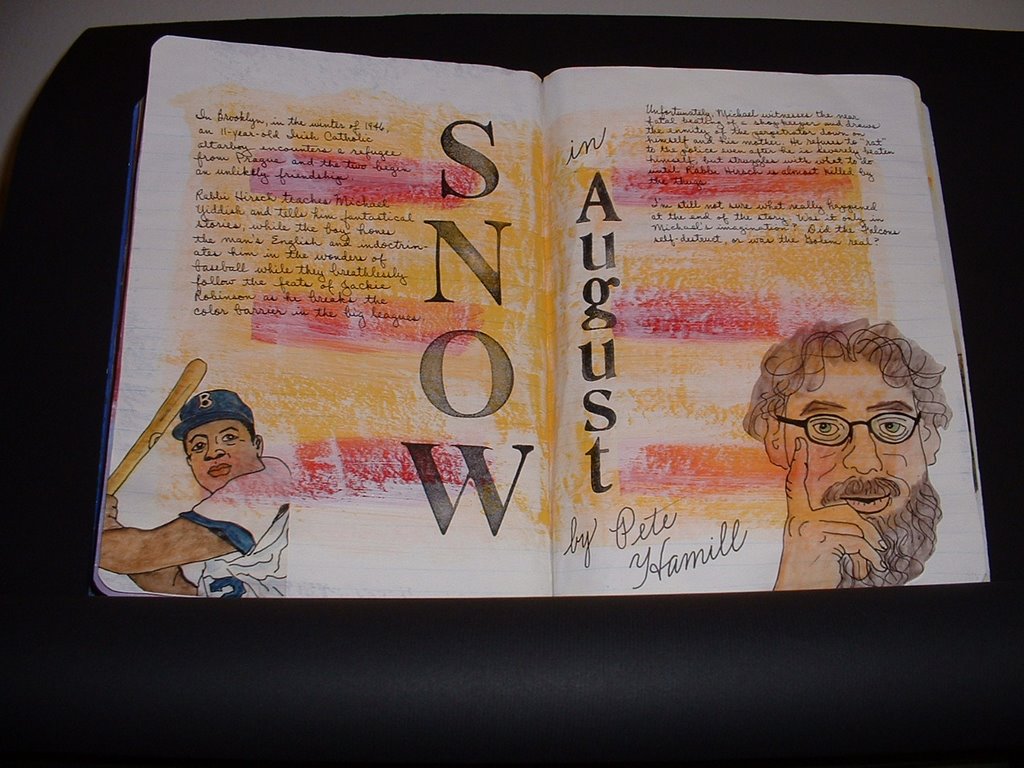
Reading Journal: "Snow in August"


In Brooklyn, in the winter of 1946, an 11-year-old Irish Catholic altarboy encounters a refugee from Prague and the two begin an unlikely friendship. Rabbi Hirsch teaches Michael Yiddish and tells him fantastical stories, while the boy hones the man's English and indoctrinates him in the wonders of baseball while they breathlessly follow the feats of Jackie Robinson as he breaks the color barrier in the big leagues. Unfortunately, Michael witnesses the near fatal beating of a shopkeeper and draws the enmity of the perpetrator down on himself and his mother. He refuses to "rat" to the police even after he is severely beaten himself, but struggles with what to do until Rabbi Hirsch is almost killed by the thugs. I'm still not sure what really happened at the end of the story. Was it only in Michael's imagination? Did the Falcons self-destruct, or was the Golem real?

This is quite a different layout for me. As I've said more than once, I prepaint my pages...and honestly, some of them are so strange that I don't see how I'll ever use them for a book review. This is certainly one of the most unusual. I had painted the centers of the pages bright yellow and topped that with those six red swashes. When it was dry, I squirted a bit of cream paint around the edges and as it began to run out, dry-brushed it over the top of the yellow and red. Serendipitously, the hot colors turned out to be reminiscent of the sweltering summer at book's end, and the overlay of cream could be taken for snow.

The illustrations on this spread are another departure from what I normally do. My drawing skills are rudimentary, to say the least. I can't sketch anything without assistance. In this case, I found some photos on the web. Printed them off and laid a piece of tracing vellum on top. Using a waterproof Pitt pen, I traced the outlines of each. Then I laid on color with Derwent "Inktense" pencils and washed them with a Niji waterbrush. Once they were good and dry, I cut around the figures and ran them through the Xyron before applying them to the corners of the pages. Because the vellum is translucent, the colors of the background show through and the drawings appear to have been done directly on the pages.

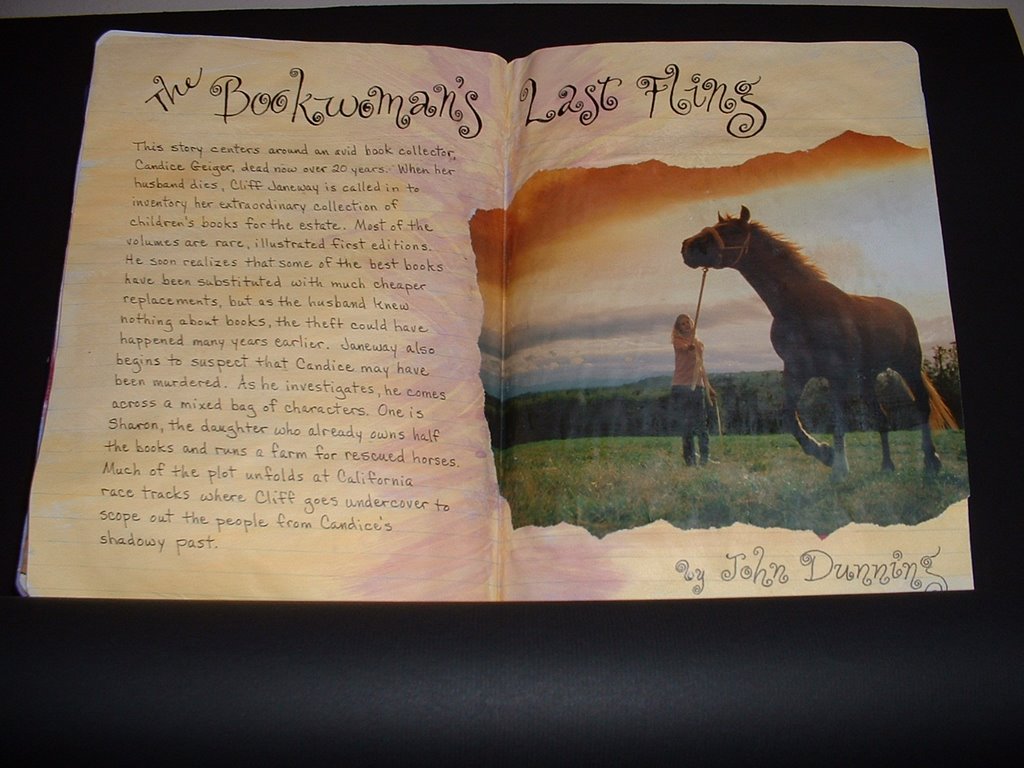
Reading Journal: "The Bookwoman's Last Fling"


This story centers around an avid book collector, Candice Geiger, dead now over 20 years. When her husband dies, Cliff Janeway is called in to inventory her extraordinary collection of children's books for the estate. Most of the volumes are rare, illustrated first editions. He soon realizes that some of the best books have been substituted with much cheaper replacements, but as the husband knew nothing about books, the theft could have happened many years earlier. Janeway also begins to suspect that Candice may have been murdered. As he investigates, he comes across a mixed bag of characters. One is Sharon, the daughter who already owns half the books and runs a farm for rescued horses. Much of the plot unfolds at California race tracks where Cliff goes undercover to scope out the people from Candice's shadowy past.

As in almost all of my reading journal spreads, this background had been painted without any book in mind. I found this photo on the cover of an investment newsletter and thought it was a good illustration for the story and the colors meshed well with these particular pages. I had made the pinkish strokes outward from the center just because I happened to have some of that color left on the brush after painting a totally different page. And as is often the case, it helped to tie the photo to the rest of the page since it's a tint of the rusty pink color at the top of the sky.

I was just playing around when I wrote out the title and author. All those curliques were a take-off on the word "Fling."

Monday, October 30, 2006

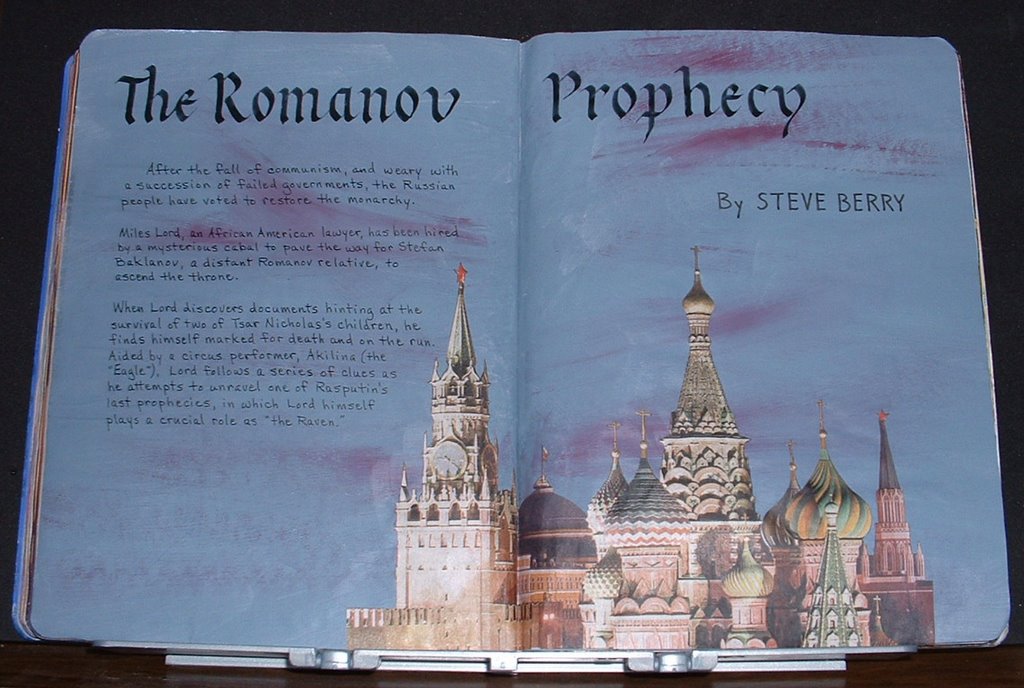
Reading Journal: The Romanov Prophecy


After the fall of communism, and weary with a succession of failed governments, the Russian people have voted to restore the monarchy. Miles Lord, an African-American lawyer, has been hired by a mysterious cabal to pave the way for Stefan Baklanov, a distant Romanov relative, to ascend the throne. When Lord discovers documents hinting at the survival of two of Tsar Nicholas's children, he finds himself marked for death and on the run. Aided by a circus performer, Akilina (the "Eagle"), Lord follows a series of clues as he attempts to unravel one of Rasputin's last prophecies, in which Lord himself plays a crucial role as "the Raven."

The background for this spread was one that I had painted ages ago, and just kept skipping over because it really didn't look right for any of the books that I wanted to review. Actually, I thought it was pretty drab until now. It never ceases to amaze me how just the right picture can improve a background. The onion domes of Red Square were from the travel section of the Sunday paper and I had saved them for years, not knowing what I would do with them. I just knew they were too pretty to throw away. What really made them work on this page was cutting away the background of the photo, so that my painted pages became the sky. It was a little tedious cutting around those tiny crosses but Fiskars micro-tip scissors were a huge help. I used matte medium to adhere the image, brushing it on a bit at the time. I've found that it's a mistake to apply any adhesive all over the back of a cut-out if it's from thin paper. The little parts will curl like mad and drive you insane. I position the image exactly where I want it on the spread, and while holding it in place with my left hand, I use a flat brush to apply the medium in one spot, smooth it down and continue adding medium until the whole thing is stuck in place. The beauty of matte medium is that it doesn't show like regular glue when any oozes out. And it brushes on more easily than glue.

I wrote the title in Gothicized Italic, using Schmincke black gouache and a Mitchell #1 nib. The author was written with a .8 Copic MultiLiner and the summary was done with a Uniball Vision micro pen.

Thursday, October 05, 2006

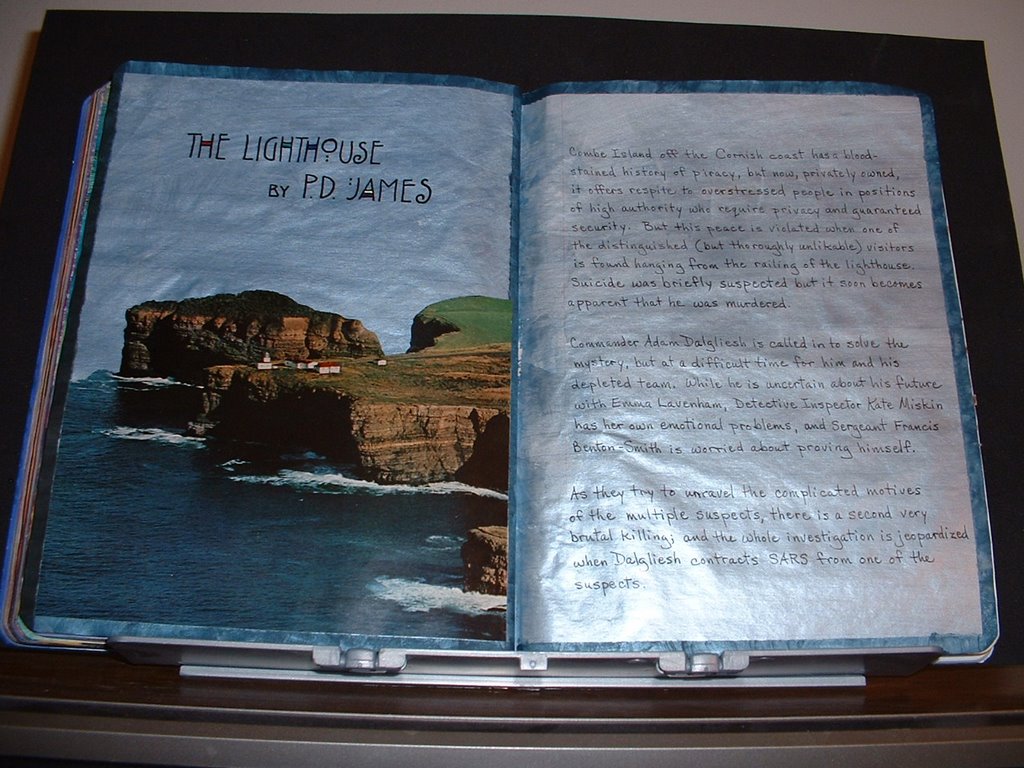
Reading Journal: The Lighthouse by P.D. James


Combe Island off the Cornish coast has a blood-stained history of piracy, but now, privately owned, it offers respite to overstressed people in positions of high authority who require privacy and guaranteed security. But this peace is violated when one of the distinguished (but thoroughly unlikable) visitors is found hanging from the railing of the lighthouse. Suicide was briefly suspected but it soon becomes apparent that he was murdered.

Commander Adam Dalgliesh is called in to solve the mystery, but at a difficult time for him and his depleted team. While he is uncertain about his future with Emma Lavenham, Detective Inspector Kate Miskin has her own emotional problems, and Sergeant Francis Benton-Smith is worried about proving himself. As they try to unravel the complicated motives of the multiple suspects, there is a second very brutal killing; and the whole investigation is jeopardized when Dalgliesh contracts SARS from one of the suspects.

The background for this spread was painted with Anita's "Silver" mixed with a small amount of "Metallic Sapphire". I was afraid that it might be difficult to write on, but I had no trouble writing out the summary with a Uniball Vision Micro pen. Despite what shows in the picture, the writing is very black and crisp. The title/author was written with a medium size Pilot Permaball. This was a new pen that I was given by Sandy Odom when I went last month to Austin to teach a class on making backgrounds. It writes permanently on all surfaces, and is acid-free, waterproof, fadeproof and smear-proof. When I heard that, I figured it was the thing to try on this shiny metallic surface. It wrote easily and dried quickly. Nothing came up when I cautiously wiped my finger over it. If it only came in a smaller point, I would be in love!

You can barely see it here, but the crossbars of the "H"s and the "A" are colored in with various colors of RoseArt gel pens for a bit of pizazz.