
Tuesday, July 05, 2005
Reading Journal Entry: Ya-Yas in Bloom
This book bounces back and forth between the 1930s (when Teensie, Vivi, Caro and Necie first met as 4-year-olds and the Ya-Yas were born) to the 1960s when they were young mothers dealing with their numerous offspring, to the present day when they rally in their intrepid manner to foil the kidnapping of a grandchild. These sassy Louisiana belles are charming, outrageous and full of life--as much a hoot as they were in Rebecca Wells two previous offerings.
 For the illustration background, I found this beautiful picture of irises and other flowers in a gardening magazine. The adorable little girls were located in various clothing ads. For the two at the top of the page, I partially cut around some of the flowers and tucked the girls behind before gluing the page down. The background of the left page was done by brushing on several shades of purple acrylics and leaving unpainted white areas. The text was done with a white GellyRoll pen.

Wednesday, June 22, 2005
Reading Journal Entry: Shroud for a Nightingale

The young women of Nightingale House are there to learn to nurse and comfort the suffering. But when one of the students takes her turn as the patient in a demonstration of nursing skills, she is horribly killed when a cleaning fluid is poured down the tube inserted in her throat. Soon another student dies and Adam Dalgliesh has his work cut out for him.
P.D. James is so quotable. Here's a good one from this book: "If you are proposing to commit a sin it is as well to commit it with intelligence. Otherwise you are insulting God as well as defying him."
This book was full of words I needed to look up:
tessellated (hall) (floor) - checkered or mottled
minatory (voice) - threatening or menacing
theurgy - miracle worker
invidious - envious or injurious
lugubrious - mournful
etiolated (neck) - lacking in strength; pale
pavane (verbal) - stately court dance
plaice - large European flounder
I found this picture of a nurse in a magazine ad. I think the bottle she is holding is STP and she is "doctoring" a car. I wanted to tone down the glossiness and make it look like she was from the 1950s, so after painting over the label on the bottle and setting her against a somber backdrop, I covered her with beige tissue paper and matte medium. I used Schmincke "Madder Red" gouache for the title, using my poor rendition of Mike Kecseg's pointed pen Blackletter alphabet.
Reading Journal Entry: Prince Edward

This book is the reminiscence of the now adult Ben Rome who is recalling the events of the summer of 1959 in Prince Edward county, Virginia. The segregationist whites in power were scrambling to set up a system of private education in response to the Brown v. Board of Education decision. As a 10-year-old, he is bewildered by these machinations, but also fascinated by the conflicting emotions that are evident in the adults around him. His sister Lainie is depressed about giving up college for marriage and an unwanted pregnancy. His parents are constantly at odds, and his twenty-something brother seems to be headed for serious trouble. As Ben and his black playmate gather eggs each day on his father's chicken farm, he worries about what will happen to Burghardt when the "separate but equal" schools are closed. In trying to understand what is going on, Ben eavesdrops and snoops, and learns more than he bargained for. Hovering over everyone like a malevolent spider is his powerful grandfather who takes perverse pleasure in humiliating Ben and anyone who can't stand up to him. This escalates beyond mere "teasing," and when it does, there is a violent consequence.
I was just about a year younger than Lainie in 1959, and I vaguely recall my classmates disputing the "rightness" of integration, but it was a few more years before it came to Nacogdoches. When it did, I had already moved away, and the whites must have become resigned to it by then, because I don't recall hearing about any violence--which is surprising considering how racist we all were back then.
My muse came through for me again. I had painted the pages of this spread with Americana brand "Graphite" acrylic to try and match the background of the eggs photo. I wrote the text with a white Gelly Roll pen since I knew it would show up well on the dark paint, although I used a white Prismacolor pencil for the title and author. Only after the fact, did I realize how perfectly it went with the theme of the book...looks just like writing on a blackboard.
Tuesday, June 21, 2005
Reading Journal Entry: The Good Neighbor

Although this author has a beautiful way with words, I did not find the plot itself particularly compelling, but it was just a necessary vehicle for the characters anyway. Every one of them was a bit strange in a Garp-like way. The Baltimore Sun recommended it "for readers who enjoy the eccentric and rambling family narratives of John Irving." That was in a review of Eddie's Bastard which I haven't read, but it certainly applies to this book, too.
A young NYC couple happen upon a 150 year-old house in Pennsylvania and buy it for two very different reasons. Colt wants it as a status symbol of his huge success in the stock market, while Francie sees it as a way to gain the peace and solitude she feels she needs as a blocked poet. Scattered throughout the narrative are glimpses of the Musgrove family that built the house and lived in it for several generations. When Francie discovers an old cemetery and a hidden journal, she is entranced by the previous inhabitants, but Colt is repelled by the idea of dead people on his property and has the bodies exhumed. This leads to some unexpected consequences from their neighbor and to a marital showdown as well.
I wrote the review on a piece of vellum. It was printed with rosebuds that you can barely see. I used a green Copic Multi-Liner pen 0.1, which worked just great on the vellum. I had previously painted the background green, so when I decided to use these pages for this spread, I added darker green strokes to simulate grass. I found the tombstones on the cover of a book about doing genealogical research. After cutting around them, I adhered them at the bottom with double-stick tape, but used some foam tape at the top to make them stand away from the page just a bit.


Reading Journal Entry: Islands
When Anny Butler marries Dr. Lewis Aiken, she becomes a member of the "Scrubs", a longtime group of Charleston friends who all have medical connections. For years, they share their free time together at a communal beach house. Then misfortune begins to plague the group, resulting in three deaths. When the story gets top-heavy with disaster, into it roars an unlikely but intriguing new character. Gaynelle Toomer, a Harley-riding, freckle-faced ex-librarian, is hired to do odd jobs for the Scrubs. She becomes a constant companion to Anny's frail friend, Camilla. Camilla, the stabilizing force of this group, turns out to be not at all what she appears, making the story's end a shocker.
Since much of the story centered on a big old beach house, it was natural to feature it as the illustrative element of this spread. I thought the warm colors that I chose for the background contrasted nicely with the dark blue of the sky, so I decided to use blue gouache to write the headings. I had seen the technique of extending an existing picture by continuing the scene past the actual boundaries, so I decided to give it a try here. Since my drawing skills are limited, this looked like something I could handle...just the sky, a road, and some grass. It's not very well done, but it was interesting to try.
Reading Journal Entry: Hard Revolution

This story is set in Washington, D.C., mostly just before and during the 1968 riots sparked by the killing of Martin Luther King, Jr. The first few chapters take place in 1959, introducing characters whose paths will entwine later. There's Derek Strange, a young black boy caught shop-lifting, but given a break that sets his life on a law-abiding path; his older brother Dennis; and their hardworking parents. By 1968, Derek is a young cop and Dennis is a pot-smoking slacker. The narrative unfolds two scenarios: a plan by Dennis and two street thugs to rob a store, and a plot by three white hoodlums to rob a bank--but only after they drunkenly kill a young black man for sport. The action is fueled by race relations and is a study of a society tearing itself apart as tensions escalate. This tale is a prequel to several other novels that feature middle-aged P.I. Derek Strange. The author, George Pelecanos, will be added to my "Want to Read" list.
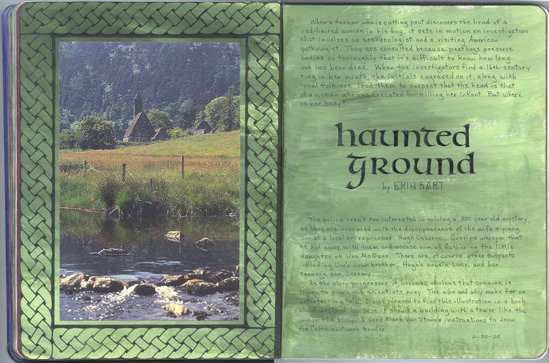
Reading Journal Entry: Haunted Ground
When a farmer who is cutting peat discovers the head of a red-haired woman in his bog, it sets in motion an investigation that involves an archaeologist and a visiting American pathologist. They are consulted because peat bogs preserve bodies so thoroughly that it's difficult to know how long one has been dead. When the investigators find a 16th-century ring in her mouth, the initials engraved on it, along with local folklore, lead them to suspect that the head is that of a woman who was executed for killing her infant. But where is her body? The police aren't too interested in solving a 500-year-old mystery, as they are occupied with the disappearance of the wife and young son of a local entrepreneur, Hugh Osborne. Gossips whisper that he did away with them, and accuse him of fathering the little daughter of Una McGann. There are, of course, other suspects including Una's dour brother, Hugh's cousin Lucy, and her teenage son Jeremy. As the story progresses, it becomes obvious that someone is trying to scare the scientists away. The who and why make for an entertaining tale.
I was pleased to find this illustration in a book about Ireland, because it shows a building with a tower like the one in the story. I spent hours working on this spread, even after using Mark Van Stone's "easy" instructions for drawing the Celtic knotwork border. Actually, he does simplify the process, but I'm so spatially challenged that it took me forever, and is far from perfect. But I like it anyway. I'm also happy with the way the lighter greens in the background that I painted before doing the knotwork, give it a dappled look, as though sunlight is reflecting on it. This is something that I could have never planned for. This is why I love slopping acrylic paints down on a page. Sometimes I get such a wonderful surprise like this after completing a spread. I truly, truly believe in my artistic muse. She only came into my life 3 years ago when I learned to just let go and trust the process. For too many years I had been a perfectionist, and wouldn't even try something until I had planned out the whole thing. I was transformed while taking Judy Melvin's class that she calls "Don't Think, Just Get It Down." And I will be privileged to take it again in September when she comes to Houston.
I was pleased to find this illustration in a book about Ireland, because it shows a building with a tower like the one in the story. I spent hours working on this spread, even after using Mark Van Stone's "easy" instructions for drawing the Celtic knotwork border. Actually, he does simplify the process, but I'm so spatially challenged that it took me forever, and is far from perfect. But I like it anyway. I'm also happy with the way the lighter greens in the background that I painted before doing the knotwork, give it a dappled look, as though sunlight is reflecting on it. This is something that I could have never planned for. This is why I love slopping acrylic paints down on a page. Sometimes I get such a wonderful surprise like this after completing a spread. I truly, truly believe in my artistic muse. She only came into my life 3 years ago when I learned to just let go and trust the process. For too many years I had been a perfectionist, and wouldn't even try something until I had planned out the whole thing. I was transformed while taking Judy Melvin's class that she calls "Don't Think, Just Get It Down." And I will be privileged to take it again in September when she comes to Houston.
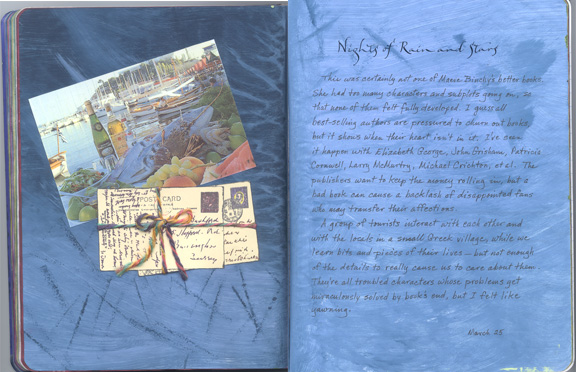
Reading Journal Entry: Nights of Rain and Stars
This was not one of Maeve Binchy's better books. She had too many characters and subplots going on, so that none of them felt fully developed. I guess all best-selling authors are pressured to churn out books, but it shows when their hearts aren't in it. I've seen it happen with Elizabeth George, John Grisham, Larry McMurtry, Michael Crichton, etc. The publishers want to keep the money rolling in, but a bad book can cause a backlash of disappointed fans who may transfer their affections. It took me years to return to Patricia Cornwell after I read her awful "Blowfly".
In this book, a group of tourists interact with each other and with the locals in a small Greek village, while we learn bits and pieces of their lives--but not enough of the details to really cause us to care about them. They're all troubled characters whose problems get miraculously solved by book's end, but I felt like yawning. I have loved most of Binchy's books, so this one was a real disappointment for me.
I had pre-painted these two pages with nothing in mind at the time. I used several different shades of blue, just randomly brushing them on. I certainly wasn't consciously trying to create the look of water, but I guess my muse was. When I had first brushed on the dark paint, it rippled the page near the gutter, so when I brushed on the lighter color it only hit the tops of the ripples. But now the page is perfectly flat after being pressed under a weight.
The picture is from a travel book about Greece, and the postcards are a rubberstamp from Aspects of Design. I stamped it twice on manilla CS, and cut them apart, then reassembled for a dimensional look. I glued a real fiber right on top of the stamped string. The title is my attempt at a modified Italic after a class taken with Sharon Zeugin.
In this book, a group of tourists interact with each other and with the locals in a small Greek village, while we learn bits and pieces of their lives--but not enough of the details to really cause us to care about them. They're all troubled characters whose problems get miraculously solved by book's end, but I felt like yawning. I have loved most of Binchy's books, so this one was a real disappointment for me.
I had pre-painted these two pages with nothing in mind at the time. I used several different shades of blue, just randomly brushing them on. I certainly wasn't consciously trying to create the look of water, but I guess my muse was. When I had first brushed on the dark paint, it rippled the page near the gutter, so when I brushed on the lighter color it only hit the tops of the ripples. But now the page is perfectly flat after being pressed under a weight.
The picture is from a travel book about Greece, and the postcards are a rubberstamp from Aspects of Design. I stamped it twice on manilla CS, and cut them apart, then reassembled for a dimensional look. I glued a real fiber right on top of the stamped string. The title is my attempt at a modified Italic after a class taken with Sharon Zeugin.
Monday, June 20, 2005

Reading Journal Entry: Slaves of Obsession
It's the summer of 1861 and William and Hester Monk find themselves in the midst of the Battle of Bull Run when they travel to America to bring back a 16-year-old girl who has run off with a Union gun buyer who is the prime suspect in the murder of the girl's father. This book had a good surprise ending. I had kind of suspected the guilty party, but not to the extent of his wickedness. I had thought he was driven to desperation by blackmailers, but not that he was the actual murderer.
Because this novel takes place partly in America during the Civil War, I decided to write the review in Spencerian Script which was a business style handwriting developed in the United States that was widespread in 19th century America. It is similar to Copperplate, but has simpler lowercase letters but very ornate capitals. It was the script used by Abraham Lincoln. By that time period, steel nibs had been invented, and by applying and releasing pressure the writer would alternately create thick and thin strokes.
Since my background color was quite dark, I wrote with white gouache. The inkwell and nib were cut from a wonderful piece of paper printed with all kinds of old-time writing tools. I found the photograph in a children's book about the Civil War, and it shows a number of injured men like the ones tended by Hester Monk. I put stickers on the 4 corners to resemble those often used in old photograph albums.
Because this novel takes place partly in America during the Civil War, I decided to write the review in Spencerian Script which was a business style handwriting developed in the United States that was widespread in 19th century America. It is similar to Copperplate, but has simpler lowercase letters but very ornate capitals. It was the script used by Abraham Lincoln. By that time period, steel nibs had been invented, and by applying and releasing pressure the writer would alternately create thick and thin strokes.
Since my background color was quite dark, I wrote with white gouache. The inkwell and nib were cut from a wonderful piece of paper printed with all kinds of old-time writing tools. I found the photograph in a children's book about the Civil War, and it shows a number of injured men like the ones tended by Hester Monk. I put stickers on the 4 corners to resemble those often used in old photograph albums.

Reading Journal Entry: The Intelligencer
In 1593, London's most popular poet and playwright was stabbed to death. The royal coroner ruled that Christopher Marlowe was killed in self-defense, but historians have long suspected otherwise, given his role as an "intelligencer" in the Queen's secret service.
This novel has interlocking narratives. The one that takes place in the present, features Kate Morgan, a Renaissance scholar, who works for a private investigative firm that doubles as an off-the-books U.S. intelligence unit. As she is trying to discover why someone is willing to kill for a 16th-century manuscript that is written in code, we are taken back to 1593 where we learn that the pages were intelligence reports compiled by Thomas Phelippes, a spymaster for Elizabeth I. The chapters alternate between the two time periods and the mysteries intersect and unfold together. The author is herself a Harvard graduate, Renaissance literature scholar, and private investigator. This was a fascinating blend of Elizabethan espionage and modern intrigue. And the author had two surprises at the end--one from each setting. I love it when a writer makes me drop my jaw!
The idea for the eye peeking through came from the cover. I went to the author's website and found the page of Elizabethan code. I was able to get a very controlled burn to "age" the edges and create the hole by using an incense stick. The first time I tried this, I just used a match, and even though I had made a damp line beyond where I wanted the burn to stop, it burned more than I intended. The incense stick worked great, although it took time and patience.
I first painted the left page with Apple Barrel "Sandstone" paint. After it was very dry, I laid down masking tape about 3/4" from the edge and painted the border and the entire right page with Delta Ceramcoat "Black Cherry." I had not burnished the edges of the tape because I wanted the paint to creep under just a bit and give a ragged look. After writing the review, I painted my hand with the red paint to make a "bloody" handprint, and flicked on a few drops of "blood." I love this spread, although one of my friends upon seeing it said, "You're weird!"
This novel has interlocking narratives. The one that takes place in the present, features Kate Morgan, a Renaissance scholar, who works for a private investigative firm that doubles as an off-the-books U.S. intelligence unit. As she is trying to discover why someone is willing to kill for a 16th-century manuscript that is written in code, we are taken back to 1593 where we learn that the pages were intelligence reports compiled by Thomas Phelippes, a spymaster for Elizabeth I. The chapters alternate between the two time periods and the mysteries intersect and unfold together. The author is herself a Harvard graduate, Renaissance literature scholar, and private investigator. This was a fascinating blend of Elizabethan espionage and modern intrigue. And the author had two surprises at the end--one from each setting. I love it when a writer makes me drop my jaw!
The idea for the eye peeking through came from the cover. I went to the author's website and found the page of Elizabethan code. I was able to get a very controlled burn to "age" the edges and create the hole by using an incense stick. The first time I tried this, I just used a match, and even though I had made a damp line beyond where I wanted the burn to stop, it burned more than I intended. The incense stick worked great, although it took time and patience.
I first painted the left page with Apple Barrel "Sandstone" paint. After it was very dry, I laid down masking tape about 3/4" from the edge and painted the border and the entire right page with Delta Ceramcoat "Black Cherry." I had not burnished the edges of the tape because I wanted the paint to creep under just a bit and give a ragged look. After writing the review, I painted my hand with the red paint to make a "bloody" handprint, and flicked on a few drops of "blood." I love this spread, although one of my friends upon seeing it said, "You're weird!"
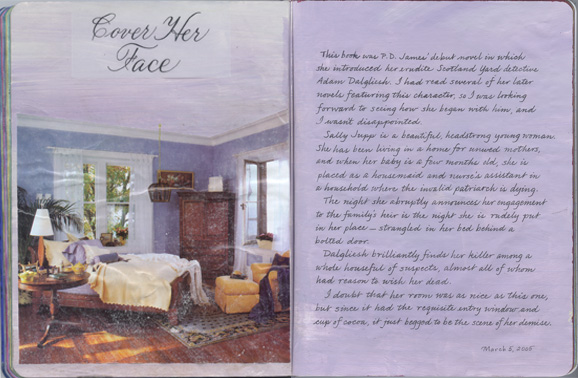
Reading Journal Entry: Cover Her Face
This book was P.D. James' debut novel in which she introduced her erudite Scotland Yard detective Adam Dalgliesh. I had read several of her later novels featuring this character, so I was looking forward to seeing how she began with him, and I wasn't disappointed.
Sally Jupp is a beautiful, headstrong young woman. She has been living in a home for unwed mothers, and when her baby is a few months old, she is placed as a housemaid and nurse's assistant in a household where the invalid patriarch is dying. The night she abruptly announces her engagement to the family's heir is the night she is rudely put in her place--strangled in her bed behind a bolted door. Dalgliesh brilliantly finds her killer among a whole houseful of suspects, almost all of whom had reason to wish her dead.
The picture was an advertisement in an interior design magazine, and I doubt that her room was as nice as this one, but since it had the requisite entry window and cup of cocoa, it just begged to be the scene of her demise. I scuffed it a bit with very fine sandpaper to age it. The title is written on a small piece of Canson Vidalon vellum. I used Scotch Vellum tape to attach it, and it really doesn't show through. The picture was cut at the edge of the crown molding, so the ceiling is actually the acrylic painted page. It is difficult to see, but if you click on it for an enlarged view, you will be able to just make out that I went over the chain of the birdcage with a gold gel pen, extending it to a hook in the "ceiling."
Sally Jupp is a beautiful, headstrong young woman. She has been living in a home for unwed mothers, and when her baby is a few months old, she is placed as a housemaid and nurse's assistant in a household where the invalid patriarch is dying. The night she abruptly announces her engagement to the family's heir is the night she is rudely put in her place--strangled in her bed behind a bolted door. Dalgliesh brilliantly finds her killer among a whole houseful of suspects, almost all of whom had reason to wish her dead.
The picture was an advertisement in an interior design magazine, and I doubt that her room was as nice as this one, but since it had the requisite entry window and cup of cocoa, it just begged to be the scene of her demise. I scuffed it a bit with very fine sandpaper to age it. The title is written on a small piece of Canson Vidalon vellum. I used Scotch Vellum tape to attach it, and it really doesn't show through. The picture was cut at the edge of the crown molding, so the ceiling is actually the acrylic painted page. It is difficult to see, but if you click on it for an enlarged view, you will be able to just make out that I went over the chain of the birdcage with a gold gel pen, extending it to a hook in the "ceiling."

Reading Journal Entry: 11th Month, 11th Day, ...
Largely through the voices of soldiers in the trenches, the author describes how both sides of the conflict sent men to die senseless deaths on November 11, 1918 right up until the final minute before the Armistice--a staggering 11,000 casualties. In this audio version, Harry Chase read all of the soldiers words in their respective accents--German, British, French, and others, and was very convincing with all of them.
Once the arrangements were made for the truce to begin at the resonant 11th hour of the 11th day of the 11th month, the armies of both sides were ordered to fight on; the idea apparently being to secure as much ground as possible before peace broke out. As a result, more died on November 11, 1918 than on D-Day a quarter-century later! This book was very revealing in the senseless stupidity of WWI in the first place, and breath-taking in the utter lack of disregard in ordering men to their deaths while peace was already agreed to. But for me, it went on too long, and I found it very disconcerting how the author constantly skipped back and forth in time.
I used khaki colored paint for the background. The numbers that make up the title were stamped with a numeral from a really old set of rubber stamps that I found in an antique store in Nacogdoches a few years ago. They are housed in a wooden box that's about 10" x 21" x 1.5" deep and appear to have been used by a teacher. The wood mounts have grooves cut that allow you to line them up on strips to spell out words in a straight line. It tickles my fancy to think that perhaps these might be from the WWI era. I used Nick Bantock's "Sapmoss Green" ink. I like how it dried with a textured look.
I found the newspaper page in a book that contained significant front pages of the New York Times, and the photo was from another book about WWI. I used some photo corners on it to make it look as though it might have come from someone's album.
Once the arrangements were made for the truce to begin at the resonant 11th hour of the 11th day of the 11th month, the armies of both sides were ordered to fight on; the idea apparently being to secure as much ground as possible before peace broke out. As a result, more died on November 11, 1918 than on D-Day a quarter-century later! This book was very revealing in the senseless stupidity of WWI in the first place, and breath-taking in the utter lack of disregard in ordering men to their deaths while peace was already agreed to. But for me, it went on too long, and I found it very disconcerting how the author constantly skipped back and forth in time.
I used khaki colored paint for the background. The numbers that make up the title were stamped with a numeral from a really old set of rubber stamps that I found in an antique store in Nacogdoches a few years ago. They are housed in a wooden box that's about 10" x 21" x 1.5" deep and appear to have been used by a teacher. The wood mounts have grooves cut that allow you to line them up on strips to spell out words in a straight line. It tickles my fancy to think that perhaps these might be from the WWI era. I used Nick Bantock's "Sapmoss Green" ink. I like how it dried with a textured look.
I found the newspaper page in a book that contained significant front pages of the New York Times, and the photo was from another book about WWI. I used some photo corners on it to make it look as though it might have come from someone's album.
Subscribe to:
Posts (Atom)