Wednesday, June 22, 2005
Reading Journal Entry: Shroud for a Nightingale
The young women of Nightingale House are there to learn to nurse and comfort the suffering. But when one of the students takes her turn as the patient in a demonstration of nursing skills, she is horribly killed when a cleaning fluid is poured down the tube inserted in her throat. Soon another student dies and Adam Dalgliesh has his work cut out for him.
P.D. James is so quotable. Here's a good one from this book: "If you are proposing to commit a sin it is as well to commit it with intelligence. Otherwise you are insulting God as well as defying him."
This book was full of words I needed to look up:
tessellated (hall) (floor) - checkered or mottled
minatory (voice) - threatening or menacing
theurgy - miracle worker
invidious - envious or injurious
lugubrious - mournful
etiolated (neck) - lacking in strength; pale
pavane (verbal) - stately court dance
plaice - large European flounder
I found this picture of a nurse in a magazine ad. I think the bottle she is holding is STP and she is "doctoring" a car. I wanted to tone down the glossiness and make it look like she was from the 1950s, so after painting over the label on the bottle and setting her against a somber backdrop, I covered her with beige tissue paper and matte medium. I used Schmincke "Madder Red" gouache for the title, using my poor rendition of Mike Kecseg's pointed pen Blackletter alphabet.
Reading Journal Entry: Prince Edward
This book is the reminiscence of the now adult Ben Rome who is recalling the events of the summer of 1959 in Prince Edward county, Virginia. The segregationist whites in power were scrambling to set up a system of private education in response to the Brown v. Board of Education decision. As a 10-year-old, he is bewildered by these machinations, but also fascinated by the conflicting emotions that are evident in the adults around him. His sister Lainie is depressed about giving up college for marriage and an unwanted pregnancy. His parents are constantly at odds, and his twenty-something brother seems to be headed for serious trouble. As Ben and his black playmate gather eggs each day on his father's chicken farm, he worries about what will happen to Burghardt when the "separate but equal" schools are closed. In trying to understand what is going on, Ben eavesdrops and snoops, and learns more than he bargained for. Hovering over everyone like a malevolent spider is his powerful grandfather who takes perverse pleasure in humiliating Ben and anyone who can't stand up to him. This escalates beyond mere "teasing," and when it does, there is a violent consequence.
I was just about a year younger than Lainie in 1959, and I vaguely recall my classmates disputing the "rightness" of integration, but it was a few more years before it came to Nacogdoches. When it did, I had already moved away, and the whites must have become resigned to it by then, because I don't recall hearing about any violence--which is surprising considering how racist we all were back then.
My muse came through for me again. I had painted the pages of this spread with Americana brand "Graphite" acrylic to try and match the background of the eggs photo. I wrote the text with a white Gelly Roll pen since I knew it would show up well on the dark paint, although I used a white Prismacolor pencil for the title and author. Only after the fact, did I realize how perfectly it went with the theme of the book...looks just like writing on a blackboard.
Tuesday, June 21, 2005
Reading Journal Entry: The Good Neighbor
Although this author has a beautiful way with words, I did not find the plot itself particularly compelling, but it was just a necessary vehicle for the characters anyway. Every one of them was a bit strange in a Garp-like way. The Baltimore Sun recommended it "for readers who enjoy the eccentric and rambling family narratives of John Irving." That was in a review of Eddie's Bastard which I haven't read, but it certainly applies to this book, too.
A young NYC couple happen upon a 150 year-old house in Pennsylvania and buy it for two very different reasons. Colt wants it as a status symbol of his huge success in the stock market, while Francie sees it as a way to gain the peace and solitude she feels she needs as a blocked poet. Scattered throughout the narrative are glimpses of the Musgrove family that built the house and lived in it for several generations. When Francie discovers an old cemetery and a hidden journal, she is entranced by the previous inhabitants, but Colt is repelled by the idea of dead people on his property and has the bodies exhumed. This leads to some unexpected consequences from their neighbor and to a marital showdown as well.
I wrote the review on a piece of vellum. It was printed with rosebuds that you can barely see. I used a green Copic Multi-Liner pen 0.1, which worked just great on the vellum. I had previously painted the background green, so when I decided to use these pages for this spread, I added darker green strokes to simulate grass. I found the tombstones on the cover of a book about doing genealogical research. After cutting around them, I adhered them at the bottom with double-stick tape, but used some foam tape at the top to make them stand away from the page just a bit.
Reading Journal Entry: Islands
When Anny Butler marries Dr. Lewis Aiken, she becomes a member of the "Scrubs", a longtime group of Charleston friends who all have medical connections. For years, they share their free time together at a communal beach house. Then misfortune begins to plague the group, resulting in three deaths. When the story gets top-heavy with disaster, into it roars an unlikely but intriguing new character. Gaynelle Toomer, a Harley-riding, freckle-faced ex-librarian, is hired to do odd jobs for the Scrubs. She becomes a constant companion to Anny's frail friend, Camilla. Camilla, the stabilizing force of this group, turns out to be not at all what she appears, making the story's end a shocker.
Since much of the story centered on a big old beach house, it was natural to feature it as the illustrative element of this spread. I thought the warm colors that I chose for the background contrasted nicely with the dark blue of the sky, so I decided to use blue gouache to write the headings. I had seen the technique of extending an existing picture by continuing the scene past the actual boundaries, so I decided to give it a try here. Since my drawing skills are limited, this looked like something I could handle...just the sky, a road, and some grass. It's not very well done, but it was interesting to try.
Reading Journal Entry: Hard Revolution
This story is set in Washington, D.C., mostly just before and during the 1968 riots sparked by the killing of Martin Luther King, Jr. The first few chapters take place in 1959, introducing characters whose paths will entwine later. There's Derek Strange, a young black boy caught shop-lifting, but given a break that sets his life on a law-abiding path; his older brother Dennis; and their hardworking parents. By 1968, Derek is a young cop and Dennis is a pot-smoking slacker. The narrative unfolds two scenarios: a plan by Dennis and two street thugs to rob a store, and a plot by three white hoodlums to rob a bank--but only after they drunkenly kill a young black man for sport. The action is fueled by race relations and is a study of a society tearing itself apart as tensions escalate. This tale is a prequel to several other novels that feature middle-aged P.I. Derek Strange. The author, George Pelecanos, will be added to my "Want to Read" list.
Reading Journal Entry: Haunted Ground
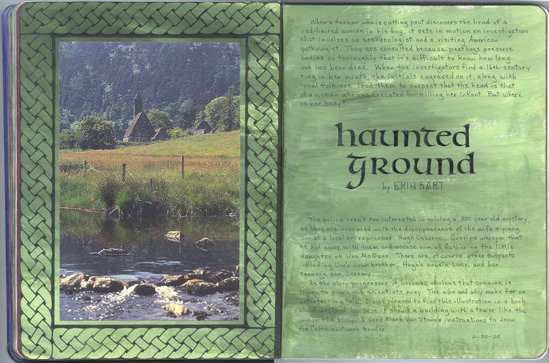
When a farmer who is cutting peat discovers the head of a red-haired woman in his bog, it sets in motion an investigation that involves an archaeologist and a visiting American pathologist. They are consulted because peat bogs preserve bodies so thoroughly that it's difficult to know how long one has been dead. When the investigators find a 16th-century ring in her mouth, the initials engraved on it, along with local folklore, lead them to suspect that the head is that of a woman who was executed for killing her infant. But where is her body? The police aren't too interested in solving a 500-year-old mystery, as they are occupied with the disappearance of the wife and young son of a local entrepreneur, Hugh Osborne. Gossips whisper that he did away with them, and accuse him of fathering the little daughter of Una McGann. There are, of course, other suspects including Una's dour brother, Hugh's cousin Lucy, and her teenage son Jeremy. As the story progresses, it becomes obvious that someone is trying to scare the scientists away. The who and why make for an entertaining tale.
I was pleased to find this illustration in a book about Ireland, because it shows a building with a tower like the one in the story. I spent hours working on this spread, even after using Mark Van Stone's "easy" instructions for drawing the Celtic knotwork border. Actually, he does simplify the process, but I'm so spatially challenged that it took me forever, and is far from perfect. But I like it anyway. I'm also happy with the way the lighter greens in the background that I painted before doing the knotwork, give it a dappled look, as though sunlight is reflecting on it. This is something that I could have never planned for. This is why I love slopping acrylic paints down on a page. Sometimes I get such a wonderful surprise like this after completing a spread. I truly, truly believe in my artistic muse. She only came into my life 3 years ago when I learned to just let go and trust the process. For too many years I had been a perfectionist, and wouldn't even try something until I had planned out the whole thing. I was transformed while taking Judy Melvin's class that she calls "Don't Think, Just Get It Down." And I will be privileged to take it again in September when she comes to Houston.
Reading Journal Entry: Nights of Rain and Stars
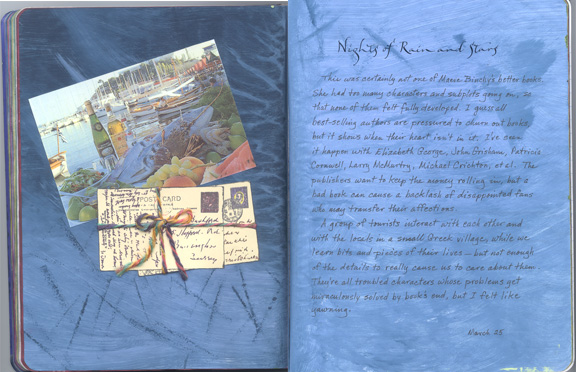
This was not one of Maeve Binchy's better books. She had too many characters and subplots going on, so that none of them felt fully developed. I guess all best-selling authors are pressured to churn out books, but it shows when their hearts aren't in it. I've seen it happen with Elizabeth George, John Grisham, Larry McMurtry, Michael Crichton, etc. The publishers want to keep the money rolling in, but a bad book can cause a backlash of disappointed fans who may transfer their affections. It took me years to return to Patricia Cornwell after I read her awful "Blowfly".
In this book, a group of tourists interact with each other and with the locals in a small Greek village, while we learn bits and pieces of their lives--but not enough of the details to really cause us to care about them. They're all troubled characters whose problems get miraculously solved by book's end, but I felt like yawning. I have loved most of Binchy's books, so this one was a real disappointment for me.
I had pre-painted these two pages with nothing in mind at the time. I used several different shades of blue, just randomly brushing them on. I certainly wasn't consciously trying to create the look of water, but I guess my muse was. When I had first brushed on the dark paint, it rippled the page near the gutter, so when I brushed on the lighter color it only hit the tops of the ripples. But now the page is perfectly flat after being pressed under a weight.
The picture is from a travel book about Greece, and the postcards are a rubberstamp from Aspects of Design. I stamped it twice on manilla CS, and cut them apart, then reassembled for a dimensional look. I glued a real fiber right on top of the stamped string. The title is my attempt at a modified Italic after a class taken with Sharon Zeugin.
In this book, a group of tourists interact with each other and with the locals in a small Greek village, while we learn bits and pieces of their lives--but not enough of the details to really cause us to care about them. They're all troubled characters whose problems get miraculously solved by book's end, but I felt like yawning. I have loved most of Binchy's books, so this one was a real disappointment for me.
I had pre-painted these two pages with nothing in mind at the time. I used several different shades of blue, just randomly brushing them on. I certainly wasn't consciously trying to create the look of water, but I guess my muse was. When I had first brushed on the dark paint, it rippled the page near the gutter, so when I brushed on the lighter color it only hit the tops of the ripples. But now the page is perfectly flat after being pressed under a weight.
The picture is from a travel book about Greece, and the postcards are a rubberstamp from Aspects of Design. I stamped it twice on manilla CS, and cut them apart, then reassembled for a dimensional look. I glued a real fiber right on top of the stamped string. The title is my attempt at a modified Italic after a class taken with Sharon Zeugin.
Monday, June 20, 2005
Reading Journal Entry: Slaves of Obsession
It's the summer of 1861 and William and Hester Monk find themselves in the midst of the Battle of Bull Run when they travel to America to bring back a 16-year-old girl who has run off with a Union gun buyer who is the prime suspect in the murder of the girl's father. This book had a good surprise ending. I had kind of suspected the guilty party, but not to the extent of his wickedness. I had thought he was driven to desperation by blackmailers, but not that he was the actual murderer.
Because this novel takes place partly in America during the Civil War, I decided to write the review in Spencerian Script which was a business style handwriting developed in the United States that was widespread in 19th century America. It is similar to Copperplate, but has simpler lowercase letters but very ornate capitals. It was the script used by Abraham Lincoln. By that time period, steel nibs had been invented, and by applying and releasing pressure the writer would alternately create thick and thin strokes.
Since my background color was quite dark, I wrote with white gouache. The inkwell and nib were cut from a wonderful piece of paper printed with all kinds of old-time writing tools. I found the photograph in a children's book about the Civil War, and it shows a number of injured men like the ones tended by Hester Monk. I put stickers on the 4 corners to resemble those often used in old photograph albums.
Because this novel takes place partly in America during the Civil War, I decided to write the review in Spencerian Script which was a business style handwriting developed in the United States that was widespread in 19th century America. It is similar to Copperplate, but has simpler lowercase letters but very ornate capitals. It was the script used by Abraham Lincoln. By that time period, steel nibs had been invented, and by applying and releasing pressure the writer would alternately create thick and thin strokes.
Since my background color was quite dark, I wrote with white gouache. The inkwell and nib were cut from a wonderful piece of paper printed with all kinds of old-time writing tools. I found the photograph in a children's book about the Civil War, and it shows a number of injured men like the ones tended by Hester Monk. I put stickers on the 4 corners to resemble those often used in old photograph albums.
Reading Journal Entry: The Intelligencer
In 1593, London's most popular poet and playwright was stabbed to death. The royal coroner ruled that Christopher Marlowe was killed in self-defense, but historians have long suspected otherwise, given his role as an "intelligencer" in the Queen's secret service.
This novel has interlocking narratives. The one that takes place in the present, features Kate Morgan, a Renaissance scholar, who works for a private investigative firm that doubles as an off-the-books U.S. intelligence unit. As she is trying to discover why someone is willing to kill for a 16th-century manuscript that is written in code, we are taken back to 1593 where we learn that the pages were intelligence reports compiled by Thomas Phelippes, a spymaster for Elizabeth I. The chapters alternate between the two time periods and the mysteries intersect and unfold together. The author is herself a Harvard graduate, Renaissance literature scholar, and private investigator. This was a fascinating blend of Elizabethan espionage and modern intrigue. And the author had two surprises at the end--one from each setting. I love it when a writer makes me drop my jaw!
The idea for the eye peeking through came from the cover. I went to the author's website and found the page of Elizabethan code. I was able to get a very controlled burn to "age" the edges and create the hole by using an incense stick. The first time I tried this, I just used a match, and even though I had made a damp line beyond where I wanted the burn to stop, it burned more than I intended. The incense stick worked great, although it took time and patience.
I first painted the left page with Apple Barrel "Sandstone" paint. After it was very dry, I laid down masking tape about 3/4" from the edge and painted the border and the entire right page with Delta Ceramcoat "Black Cherry." I had not burnished the edges of the tape because I wanted the paint to creep under just a bit and give a ragged look. After writing the review, I painted my hand with the red paint to make a "bloody" handprint, and flicked on a few drops of "blood." I love this spread, although one of my friends upon seeing it said, "You're weird!"
This novel has interlocking narratives. The one that takes place in the present, features Kate Morgan, a Renaissance scholar, who works for a private investigative firm that doubles as an off-the-books U.S. intelligence unit. As she is trying to discover why someone is willing to kill for a 16th-century manuscript that is written in code, we are taken back to 1593 where we learn that the pages were intelligence reports compiled by Thomas Phelippes, a spymaster for Elizabeth I. The chapters alternate between the two time periods and the mysteries intersect and unfold together. The author is herself a Harvard graduate, Renaissance literature scholar, and private investigator. This was a fascinating blend of Elizabethan espionage and modern intrigue. And the author had two surprises at the end--one from each setting. I love it when a writer makes me drop my jaw!
The idea for the eye peeking through came from the cover. I went to the author's website and found the page of Elizabethan code. I was able to get a very controlled burn to "age" the edges and create the hole by using an incense stick. The first time I tried this, I just used a match, and even though I had made a damp line beyond where I wanted the burn to stop, it burned more than I intended. The incense stick worked great, although it took time and patience.
I first painted the left page with Apple Barrel "Sandstone" paint. After it was very dry, I laid down masking tape about 3/4" from the edge and painted the border and the entire right page with Delta Ceramcoat "Black Cherry." I had not burnished the edges of the tape because I wanted the paint to creep under just a bit and give a ragged look. After writing the review, I painted my hand with the red paint to make a "bloody" handprint, and flicked on a few drops of "blood." I love this spread, although one of my friends upon seeing it said, "You're weird!"
Reading Journal Entry: Cover Her Face
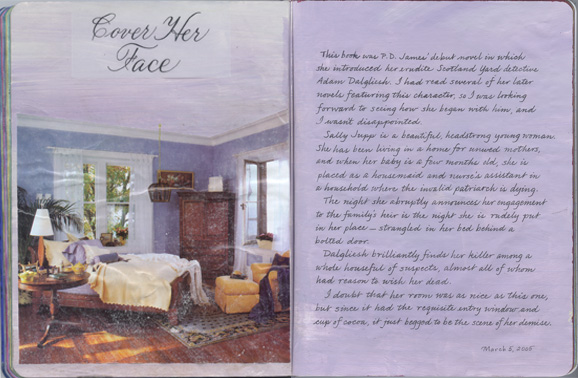
This book was P.D. James' debut novel in which she introduced her erudite Scotland Yard detective Adam Dalgliesh. I had read several of her later novels featuring this character, so I was looking forward to seeing how she began with him, and I wasn't disappointed.
Sally Jupp is a beautiful, headstrong young woman. She has been living in a home for unwed mothers, and when her baby is a few months old, she is placed as a housemaid and nurse's assistant in a household where the invalid patriarch is dying. The night she abruptly announces her engagement to the family's heir is the night she is rudely put in her place--strangled in her bed behind a bolted door. Dalgliesh brilliantly finds her killer among a whole houseful of suspects, almost all of whom had reason to wish her dead.
The picture was an advertisement in an interior design magazine, and I doubt that her room was as nice as this one, but since it had the requisite entry window and cup of cocoa, it just begged to be the scene of her demise. I scuffed it a bit with very fine sandpaper to age it. The title is written on a small piece of Canson Vidalon vellum. I used Scotch Vellum tape to attach it, and it really doesn't show through. The picture was cut at the edge of the crown molding, so the ceiling is actually the acrylic painted page. It is difficult to see, but if you click on it for an enlarged view, you will be able to just make out that I went over the chain of the birdcage with a gold gel pen, extending it to a hook in the "ceiling."
Sally Jupp is a beautiful, headstrong young woman. She has been living in a home for unwed mothers, and when her baby is a few months old, she is placed as a housemaid and nurse's assistant in a household where the invalid patriarch is dying. The night she abruptly announces her engagement to the family's heir is the night she is rudely put in her place--strangled in her bed behind a bolted door. Dalgliesh brilliantly finds her killer among a whole houseful of suspects, almost all of whom had reason to wish her dead.
The picture was an advertisement in an interior design magazine, and I doubt that her room was as nice as this one, but since it had the requisite entry window and cup of cocoa, it just begged to be the scene of her demise. I scuffed it a bit with very fine sandpaper to age it. The title is written on a small piece of Canson Vidalon vellum. I used Scotch Vellum tape to attach it, and it really doesn't show through. The picture was cut at the edge of the crown molding, so the ceiling is actually the acrylic painted page. It is difficult to see, but if you click on it for an enlarged view, you will be able to just make out that I went over the chain of the birdcage with a gold gel pen, extending it to a hook in the "ceiling."
Reading Journal Entry: 11th Month, 11th Day, ...
Largely through the voices of soldiers in the trenches, the author describes how both sides of the conflict sent men to die senseless deaths on November 11, 1918 right up until the final minute before the Armistice--a staggering 11,000 casualties. In this audio version, Harry Chase read all of the soldiers words in their respective accents--German, British, French, and others, and was very convincing with all of them.
Once the arrangements were made for the truce to begin at the resonant 11th hour of the 11th day of the 11th month, the armies of both sides were ordered to fight on; the idea apparently being to secure as much ground as possible before peace broke out. As a result, more died on November 11, 1918 than on D-Day a quarter-century later! This book was very revealing in the senseless stupidity of WWI in the first place, and breath-taking in the utter lack of disregard in ordering men to their deaths while peace was already agreed to. But for me, it went on too long, and I found it very disconcerting how the author constantly skipped back and forth in time.
I used khaki colored paint for the background. The numbers that make up the title were stamped with a numeral from a really old set of rubber stamps that I found in an antique store in Nacogdoches a few years ago. They are housed in a wooden box that's about 10" x 21" x 1.5" deep and appear to have been used by a teacher. The wood mounts have grooves cut that allow you to line them up on strips to spell out words in a straight line. It tickles my fancy to think that perhaps these might be from the WWI era. I used Nick Bantock's "Sapmoss Green" ink. I like how it dried with a textured look.
I found the newspaper page in a book that contained significant front pages of the New York Times, and the photo was from another book about WWI. I used some photo corners on it to make it look as though it might have come from someone's album.
Once the arrangements were made for the truce to begin at the resonant 11th hour of the 11th day of the 11th month, the armies of both sides were ordered to fight on; the idea apparently being to secure as much ground as possible before peace broke out. As a result, more died on November 11, 1918 than on D-Day a quarter-century later! This book was very revealing in the senseless stupidity of WWI in the first place, and breath-taking in the utter lack of disregard in ordering men to their deaths while peace was already agreed to. But for me, it went on too long, and I found it very disconcerting how the author constantly skipped back and forth in time.
I used khaki colored paint for the background. The numbers that make up the title were stamped with a numeral from a really old set of rubber stamps that I found in an antique store in Nacogdoches a few years ago. They are housed in a wooden box that's about 10" x 21" x 1.5" deep and appear to have been used by a teacher. The wood mounts have grooves cut that allow you to line them up on strips to spell out words in a straight line. It tickles my fancy to think that perhaps these might be from the WWI era. I used Nick Bantock's "Sapmoss Green" ink. I like how it dried with a textured look.
I found the newspaper page in a book that contained significant front pages of the New York Times, and the photo was from another book about WWI. I used some photo corners on it to make it look as though it might have come from someone's album.
Reading Journal Entry: New Mercies
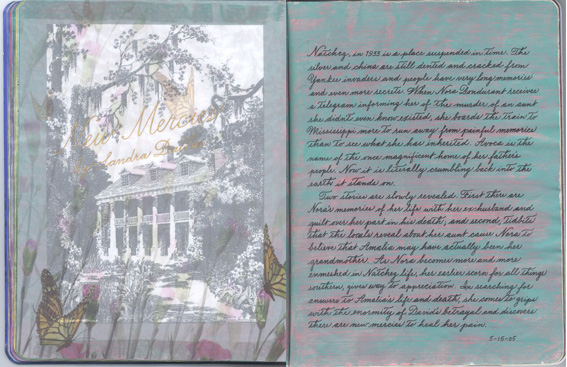
Natchez, in 1933 is a place suspended in time. The silver and china are still dented and cracked from Yankee invaders and people have very long memories and even more secrets. When Nora Bondurant receives a telegram informing her of the murder of an aunt she didn't even know existed, she boards the train to Mississippi more to run away from painful memories than to see what she has inherited. Avoca is the name of the once magnificent home of her father's people. Now it is literally crumbling bck into the earth it stands on.
Two stories are slowly revealed. First there are Nora's memories of her life with her ex-husband and guilt over her part in his death; and second, tidbits that the locals reveal about her aunt cause Nora to believe that Amalia may have actually been her grandmother. As Nora becomes more and more enmeshed in Natchez life, her earlier scorn for all things southern, gives way to appreciation. In searching for answers to Amalia's life and death, she comes to grips with the enormity of David's betrayal and discovers there are new mercies to heal her pain.
The background for these pages was made by first brushing them with a quinacridone magenta glaze. When that was dry, I brushed on Anita's acrylic paint in "Running River" green. Before it was completely dry, a damp piece of boat sponge was pulled across to lift off parts of the paint, letting the magenta glaze show through.
The left page features a photocopy of a Natchez antebellum home, covered with a piece of printed vellum (that's the flowers and butterflies.) I used a pointed nib and Dr. Martin's Iridescent Calligraphy Color in "Copperplate Gold" to write the title and author.
Two stories are slowly revealed. First there are Nora's memories of her life with her ex-husband and guilt over her part in his death; and second, tidbits that the locals reveal about her aunt cause Nora to believe that Amalia may have actually been her grandmother. As Nora becomes more and more enmeshed in Natchez life, her earlier scorn for all things southern, gives way to appreciation. In searching for answers to Amalia's life and death, she comes to grips with the enormity of David's betrayal and discovers there are new mercies to heal her pain.
The background for these pages was made by first brushing them with a quinacridone magenta glaze. When that was dry, I brushed on Anita's acrylic paint in "Running River" green. Before it was completely dry, a damp piece of boat sponge was pulled across to lift off parts of the paint, letting the magenta glaze show through.
The left page features a photocopy of a Natchez antebellum home, covered with a piece of printed vellum (that's the flowers and butterflies.) I used a pointed nib and Dr. Martin's Iridescent Calligraphy Color in "Copperplate Gold" to write the title and author.
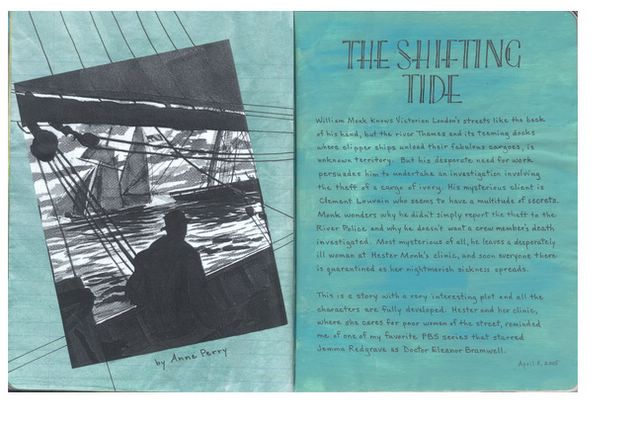
Reading Journal Entry: The Shifting Tide
William Monk knows Victorian London's streets like the back of his hand, but the river Thames and its teeming docks where clipper ships unload their fabulous cargoes, is unknown territory. But his desperate need for work persuades him to undertake an investigation involving the theft of a cargo of ivory. His mysterious client is Clement Louvain who seems to have a multitude of secrets. Monk wonders why he didn't simply report the theft to the River Police and why he doesn't want a crew member's death investigated. Most mysterious of all, he leaves a desperately ill woman at Hester Monk's clinic, and soon everyone there is quarantined as her nightmarish sickness spreads.
This is a story with a very interesting plot and all the characters are fully developed. Hester and her clinic, where she cares for poor women of the street, reminded me of one of my favorite PBS series that starred Jemma Redgrave as Doctor Eleanor Bramwell.
I've read several books by Anne Perry recently, and this is my favorite in the Monk series. I am quite pleased with the illustration that I found to accompany the review. I think it is evocative of the sinister mood of this story. I found it in a book about clipper ships. Using a black Pitt pen, I extended the lines of the sails and ropes to lead the viewer's eye completely off the page. Angling the picture seemed to be in keeping with how off-balance the main characters felt as they were manipulated by the antagonist. I tried to emulate an alphabet from an exemplar that I got from Alan Blackman many years ago. I believe it can be found in the book "Sixty Alphabets" published by Thames and Hudson. I wrote it with black gouache, using a #4 Mitchell nib.
This is a story with a very interesting plot and all the characters are fully developed. Hester and her clinic, where she cares for poor women of the street, reminded me of one of my favorite PBS series that starred Jemma Redgrave as Doctor Eleanor Bramwell.
I've read several books by Anne Perry recently, and this is my favorite in the Monk series. I am quite pleased with the illustration that I found to accompany the review. I think it is evocative of the sinister mood of this story. I found it in a book about clipper ships. Using a black Pitt pen, I extended the lines of the sails and ropes to lead the viewer's eye completely off the page. Angling the picture seemed to be in keeping with how off-balance the main characters felt as they were manipulated by the antagonist. I tried to emulate an alphabet from an exemplar that I got from Alan Blackman many years ago. I believe it can be found in the book "Sixty Alphabets" published by Thames and Hudson. I wrote it with black gouache, using a #4 Mitchell nib.
Reading Journal Entry: My Jim
Told entirely in dialect, this first-person narrative features Sadie, a slave emancipated during the Civil War. While making a quilt with her granddaughter who was born free and is trying to decide whether to marry and move west, Sadie is inspired to tell the story of her own separation and loss. In particular, Sadie recalls her husband Jim, and their two children. Jim was sold away and later escaped to freedom with none other than Huckleberry Finn (a detail that is not further developed.) As Sadie tells her story, three objects play recurring roles-- an African bowl that came from her own grandmother, a small knife inherited from her mother, and a hat that had belonged to Jim.
I had a lot of fun making the illustration for this book. After glazing the pages with a mixture of Golden's Yellow Oxide fluid acrylic and Soft Gel Matte Medium, I added a touch of soft red by pulling a sponge across the pages in a few places. I wrote the title with a #1 Mitchell nib and walnut ink. It doesn't show up very well in the scan, but I drew in some tiny lines on the letters with a dark brown Pitt artist pen (size S) to simulate the look of ones carved into wood. Since a small knife plays a recurring role in the story, this seemed apropos.
The main characters kept their hands busy making a quilt while the story progressed. This gave me the inspiration for making a paper quilt on the right-hand page. I actually used my sewing machine to stitch around the woman's picture, although the other "stitches" are drawn with a micro pen. The triangles were cut from bits of scrapbooking paper and attached to a piece of sticker paper. I even mitered the corners of the quilt's border for a more authentic look.
I had a lot of fun making the illustration for this book. After glazing the pages with a mixture of Golden's Yellow Oxide fluid acrylic and Soft Gel Matte Medium, I added a touch of soft red by pulling a sponge across the pages in a few places. I wrote the title with a #1 Mitchell nib and walnut ink. It doesn't show up very well in the scan, but I drew in some tiny lines on the letters with a dark brown Pitt artist pen (size S) to simulate the look of ones carved into wood. Since a small knife plays a recurring role in the story, this seemed apropos.
The main characters kept their hands busy making a quilt while the story progressed. This gave me the inspiration for making a paper quilt on the right-hand page. I actually used my sewing machine to stitch around the woman's picture, although the other "stitches" are drawn with a micro pen. The triangles were cut from bits of scrapbooking paper and attached to a piece of sticker paper. I even mitered the corners of the quilt's border for a more authentic look.
Sunday, June 19, 2005
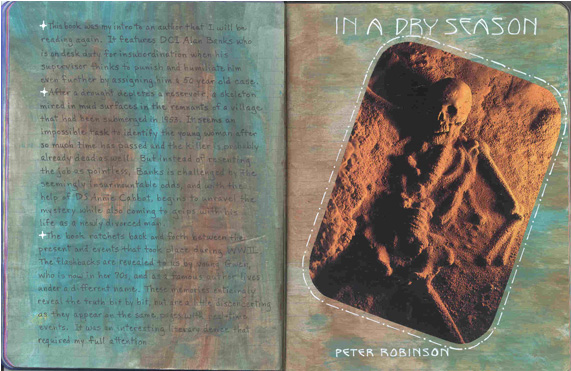
Reading Journal Entry: In A Dry Season
This was the first book I had ever read by Peter Robinson. I love a good mystery, and I particularly have a thing for those that are set in England, so I was delighted to discover this author who will take his place alongside P.D. James, Elizabeth George, Ruth Rendell, Deborah Crombie, John Harvey and Stephen Booth (to name a few of my favorites.)
It features DCI Alan Banks who is on desk duty for insubordination when his supervisor thinks to punish and humiliate him even further by assigning him a 50 year old cold case. After a drought depletes a reservoir, a skeleton mired in mud surfaces in the remnants of a village that had been submerged in 1953. It seems an impossible task to identify the young woman after so much time has passed and the killer is probably already dead as well. But instead of resenting the job as pointless, Banks is challenged by the seemingly insurmountable odds, and with the help of DS Annie Cabbot, begins to unravel the mystery while also coming to grips with his life as a newly divorced man.
The book ratchets back and forth between the present and events that took place during WWII. The flashbacks are revealed to us by young Gwen, who is now in her 70s, and as a famous author lives under a different name. These memories enticingly reveal the truth bit by bit, but are a little disconcerting as they appear on the same pages with real-time events. It was an interesting literary device that required my full attention.
The background for these pages was Anita's brand acrylic paint in "Turquoise" and "Moccasin Brown". The white writing was done with a Gelly Roll pen in the Art Nouveau alphabet. I put lines and dots around the illustration to set it off.
It features DCI Alan Banks who is on desk duty for insubordination when his supervisor thinks to punish and humiliate him even further by assigning him a 50 year old cold case. After a drought depletes a reservoir, a skeleton mired in mud surfaces in the remnants of a village that had been submerged in 1953. It seems an impossible task to identify the young woman after so much time has passed and the killer is probably already dead as well. But instead of resenting the job as pointless, Banks is challenged by the seemingly insurmountable odds, and with the help of DS Annie Cabbot, begins to unravel the mystery while also coming to grips with his life as a newly divorced man.
The book ratchets back and forth between the present and events that took place during WWII. The flashbacks are revealed to us by young Gwen, who is now in her 70s, and as a famous author lives under a different name. These memories enticingly reveal the truth bit by bit, but are a little disconcerting as they appear on the same pages with real-time events. It was an interesting literary device that required my full attention.
The background for these pages was Anita's brand acrylic paint in "Turquoise" and "Moccasin Brown". The white writing was done with a Gelly Roll pen in the Art Nouveau alphabet. I put lines and dots around the illustration to set it off.
Thursday, April 28, 2005
Reading Journal Entry: The Lost Mother
For the illustration of this book review, I decided to use a photo of my mother who was a child during the Depression. It was serendipitous that the only photo I have of her during that era shows her holding a cat, since one poignant episode in the book is what happens to Margaret's cat and Thomas's part in that. A significant, recurring theme in this story is Thomas's ambivalent feelings toward Margaret. It is obvious that he loves her and feels responsible for her well-being, but she also aggravates and exasperates him. Sometimes this leads him to do mean things to her, which he regrets even as a 70-year-old.
I wrote the title in casual Roman caps that I learned from Sherri Kiesel. These were done with a black .8 Copic Multiliner pen, with the horizontal lines drawn by a Scarlet Red Prismacolor pencil. The background is acrylic paint in three shades of green (Celedon, Sage, English Ivy) with touches of Sandstone. The text was written with a .05 Copic pen.
Tuesday, April 26, 2005
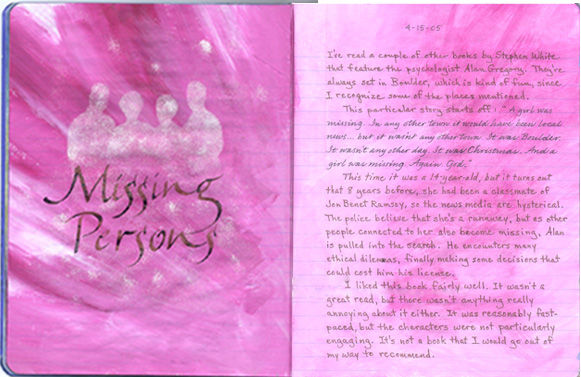
Reading Journal Entry: "Missing Persons"
I've read a couple of other books by Stephen White that feature the psychologist Alan Gregory. They're always set in Boulder, which is kind of fun, since I recognize some of the places mentioned. This particular story starts off:
"A girl was missing. In any other town it would have been local news...but it wasn't any other town. It was Boulder. It wasn't any other day. It was Christmas. And a girl was missing. Again. God."This time it was a 14-year-old, but it turns out that 8 years before, she had been a classmate of Jon Benet Ramsey, so the news media are hysterical. The police believe that she's a runaway, but as other people connected to her also become missing, Alan is pulled into the search. He encounters many ethical dilemmas, finally making some decisions that could cost him his license.
I like this book fairly well. It wasn't a great read, but there wasn't anything really annoying about it either. It was reasonably fast-paced, but the characters were not particularly engaging. It's not a book that I would go out of my way to recommend.
It doesn't show particularly well in the scan, but the silhouettes of the people are speckled with white in imitation of snow. This was acrylic paint applied with a sponge over a stencil cut from an actual photograph of four people. I didn't want their features to show, as a way to indicate the theme of people who are missing. I am not at all happy with the way I wrote the title. I used walnut ink, and seemed to have no control over how it came out of the pen. Note to self: Gouache works so much better on these acrylic-painted pages.
Reading Journal Entry: "A Christmas Visitor"
This novella features one of the characters of the William Monk series. Henry Rathbone is a distinguished mathematician and the father of Sir Oliver Rathbone (a one-time suitor of Hester Monk.) He is summoned to the Lake District by his goddaughter Antonia Dreghorne, whose husband has recently died in what appeared to be a senseless accident. But his good name is being smeared by a man he sent to prison for 11 years, and now Judge Dreghorne's wife and brothers fear he was murdered by Ashton Gower. This was a pleasant little read, but far from gripping. A bit of trivia that tickled me were the whimsical names of the jams that Henry had for breakfast: witherslacks (damson plum), black kite (blackberry) and hinberry (raspberry)
I made the illustration for this book review by first painting the pages with purple acrylic paints. The estate that is at the heart of the story was represented by tearing around a picture of a home that I found in a British tourism magazine. To soften the torn edges and blend them into the background, I used rubberstamping pigment inks on a fingertip dauber. The title was written with gold gouache, while the author's name was gold gouache with a bit of indigo added to it.
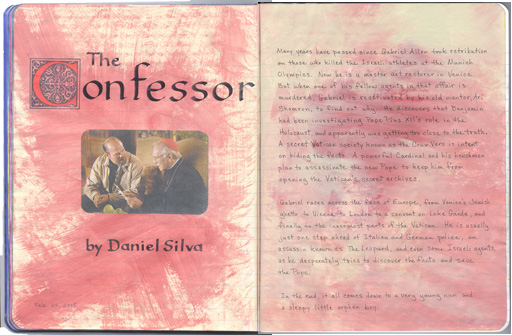
Reading Journal entry: "The Confessor"
Many years have passed since Gabriel Allon took retribution on those who killed the Israeli athletes at the Munich Olympics. Now he is a master art restorer in Venice. But when one of his fellow agents in that affair is murdered, Gabriel is reactivated by his old mentor, Ari Shamron, to find out why. He discovers that Benjamin had been investigating Pope Pius XII's role in the Holocaust, and apparently was getting too close to the truth. A secret Vatican society known as the Crux Vera is intent on hiding the facts. A powerful Cardinal and his henchmen plan to assassinate the new Pope to keep him from opening the Vatican's secret archives. Gabriel races across the face of Europe, from Venice's Jewish ghetto to Vienna to London to a convent on Lake Garda, and finally to the innermost parts of the Vatican. He is usually just one step ahead of Italian and German police, an assassin known as The Leopard, and even some Israeli agents, as he desperately tries to discover the facts and save the Pope. In the end, it all comes down to a very young nun and a sleepy little orphan boy.
I was reading it about the time that Pope John Paul was in his final illness, and one of the characters in the book is the imaginary pope who follows him.
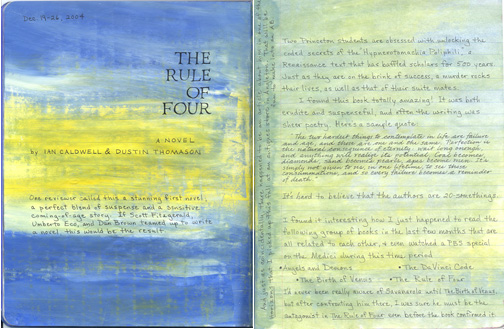
Reading Journal entry: The Rule of Four
One reviewer called this a stunning first novel; a perfect blend of suspense and a sensitive coming-of-age story. If Scott Fitzgerald, Umberto Eco, and Dan Brown teamed up to write a novel, this would be the result.
Two Princeton students are obsessed with unlocking the coded secrets of the "Hypnerotomachia Poliphili", a Renaissance text that has baffled scholars for 500 years. Just as they are on the brink of success, a murder rocks their lives, as well as that of their suite mates.
I found this book totally amazing! It was both erudite and suspenseful, and often the writing was sheer poetry. Here's a sample quote:
"The two hardest things to contemplate in life are failure and age; and those are one and the same. Perfection is the natural consequence of eternity: wait long enough, and anything will realize its potential. Coal becomes diamonds, sand becomes pearls, apes become men. It's simply not given to us, in one lifetime, to see those consummations, and so every failure becomes a reminder of death."
It's hard to believe that the authors are 20-somethings.
I found it interesting how I just happened to read the following group of books in the last few months that are all related to each other, and even watched a PBS special on the Medici during this time period:
Two Princeton students are obsessed with unlocking the coded secrets of the "Hypnerotomachia Poliphili", a Renaissance text that has baffled scholars for 500 years. Just as they are on the brink of success, a murder rocks their lives, as well as that of their suite mates.
I found this book totally amazing! It was both erudite and suspenseful, and often the writing was sheer poetry. Here's a sample quote:
"The two hardest things to contemplate in life are failure and age; and those are one and the same. Perfection is the natural consequence of eternity: wait long enough, and anything will realize its potential. Coal becomes diamonds, sand becomes pearls, apes become men. It's simply not given to us, in one lifetime, to see those consummations, and so every failure becomes a reminder of death."
It's hard to believe that the authors are 20-somethings.
I found it interesting how I just happened to read the following group of books in the last few months that are all related to each other, and even watched a PBS special on the Medici during this time period:
- Angels and Demons
- The DaVinci Code
- The Birth of Venus
- The Rule of Four
Tuesday, March 22, 2005

I have been working in an altered book belonging to my friend Dixie. It is called 'Zen and the Art of Travel'. One definition of Zen is "the attainment of enlightenment by means of paradoxical and nonlogical statements." I photocopied the frogs from a Dover clipart book and gave them life with Prismacolor pencils. They are mounted with foam tape so they don't quite touch the page, which gives them a 3-D look and makes you think they might be about to jump. I was intrigued with the idea of what could possibly be going through their little froggy minds as they contemplate the Golden Gate Bridge. Have they ever observed someone leaping off the bridge? This rather black humor led me to the question that I penned on the opposite page, which was written on a piece of Glad Tidings scrapbook paper with a #22 Hunt nib and gouache.

This is another spread in Dixie's book with a bit of whimsy. The modern jet aircraft was original to the book; I added the man strapped to the fantastical device as a Zen touch. You can't quite get the full effect from viewing it on a computer because he was flattened while being scanned, but in actuality, the man's limbs curve away from the page to add to the illusion of being airborne. The quote by Charles Lindbergh was made regarding his first parachute jump. He said, "It was a love of the air and sky and flying, the lure of adventure, the appreciation of beauty...where immortality is touched through danger, where life meets death on equal plane." I wrote it with a #6 Mitchell nib and Schmincke Burnt Sienna gouache on a piece of black Ingres paper.

This barren landscape and the quote by Emerson that says, "The difference between landscape and landscape is small, but there is a great difference between the beholders," led me to contemplate two very different types who live a world apart, but in similar surroundings. My observation was written with a Pilot P-500 pen in a journaling script called Akim. I chose it because it has somewhat of an Arabic look with its tall verticals, tiny "o"s, and long horizontal swings. The red lines were drawn with a Prismacolor pencil. This is my take on the men pictured: "What a dichotomy of two desert dwellers! One a veritable merchant of death--evil incarnate--while the sandpainter's mission is to invoke cures, create blessings, and restore harmony between man and nature."

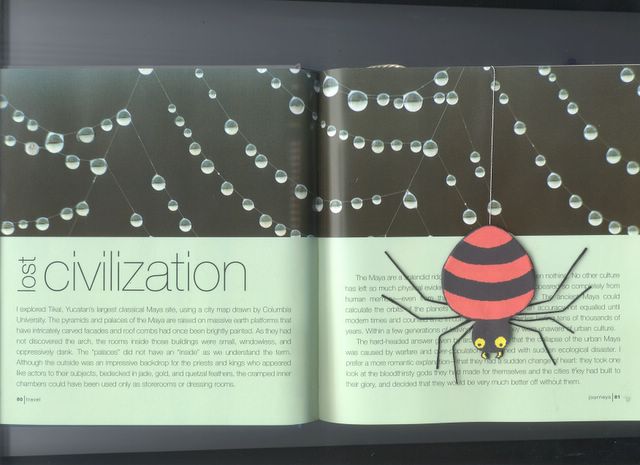
The last spread in Dixie's book is about the lost civilization of the Maya. The dewdrops were already there on the cobwebs, but I enhanced them with a bit of gold Pearl Ex mixed into Diamond Glaze. The spider was created by gluing a paper image to black Fun-Foam and giving him legs made of embroidery thread stiffened with PVA. He hands by a silver thread. The ancient Maya could calculate the orbits of the planets around the sun with an accuracy not equaled until modern times, yet their massive pyramids and palaces are now inhabited only by arachnids. How zen!
Thursday, February 17, 2005
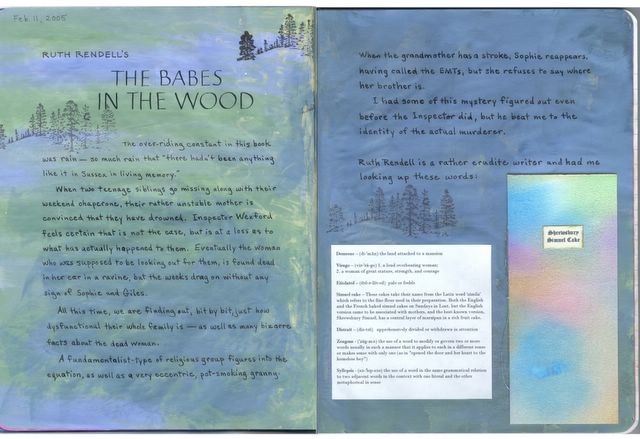
Reading Journal - "The Babes in the Woods"
The over-riding constant in this book was rain--so much rain that there hadn't been anything like it in Sussex in living memory. When two teenage siblings go missing along with their weekend chaperone, their rather unstable mother is convinced that they have drowned. Inspector Wexford feels certain that is not the case, but is at a loss as to what has actually happened to them. Eventually the woman who was supposed to be looking out for them, is found dead in her car in a ravine, but the weeks drag on without any sign of Sophie and Giles. All this time, we are finding out, bit by bit, just how dysfunctional their whole family is--as well as many bizarre facts about the dead woman. A fundamentalist-type religious group figures into the equation, as well as a very eccentric, pot-smoking granny. When the grandmother has a stroke, Sophie reappears, having called the EMTs, but she refuses to say where her brother is.
I had some of this mystery figured out even before the Inspector did, but he beat me to the identity of the actual murderer.
I decided to take one of Alberto Manguel's suggestions and improve my vocabulary by jotting down words I did not previously know, along with their definitions. These were Demesne, Virago, Etiolated, Distrait, Zeugma, Syllepsis, and the one that intrigued me the most was Simnel Cake. I went online to find a recipe, which I pasted into the small booklet on the right side. The cover for that was made by wetting a piece of Arches Text Wove paper and dropping on diluted Plaka paints and diluted Holbein Pearl Gold gouache. Then the wet paper was picked up and shifted around to get the colors to mingle. Of course, the scan doesn't do it justice, but in person it is so shimmery and beautiful.
Monday, February 07, 2005
"A Song I Knew by Heart" by Bret Lott

This book is about the healing power of family. When Naomi's son dies and leaves his mother and wife bereft--awash in their individual and shared sorrows, they find strength in their love for each other. When Naomi suddenly decides to leave Massachusetts after 50 years and return to her childhood home in South Carolina, Ruth goes with her. They are welcomed by extended family, some of whom they barely know--and others not at all. They are flooded with a love they are nearly too fragile to accept.
Naomi is also dealing with the guilt she still feels after betraying her husband 40-odd years before. When she discovers that he had known all along and forgiven her anyway, she is at first devastated--but the knowledge of his forgiveness at long last allows her to forgive herself--and to permit Ruth to love again, too.
Here is a quote from Naomi:
"I felt all this, and knew suddenly and deeply and fully what it meant to be alive, because I seemed in this small moment so very far from it: to be alive was to be the one in bed and to have lived your life so that there would be someone beside you, someone there to hold your hand no matter the cold of it or the dead white skin and frail bones hiding underneath that skin. No matter the cluster of ghosts you carried with you every breath you took in. And to be alive was to live in a way such that you were both of these people: the comforted and the comforting, the loved and the loving, so that finally all you were, all that you had lived your life to become, the sum total of each sunrise and sunset you'd ever managed to witness, was to love. To live was to receive love, and to give it away."The images on this page are rubber stamps painted with Prismacolor pencils and outlined with a metallic gold gel pen. I've found that the chalky feel of the craft paints that I use on most of my backgrounds will destroy gel pens if used too extensively, but you can get away with using them in limited amounts.
Thursday, February 03, 2005
"A Death in Vienna" by Daniel Silva

I listened to this audio book on the way to Nacogdoches and was hoping it would last long enough to see me back home as well, but it concluded about the time I passed by the airport. I enjoyed it enough so that I got another book by Mr. Silva when I went to the library on Monday. When I checked online, I discovered that he has written 7 books in 7 years, and 3 of them comprise what he calls "an accidental trilogy dealing with the unfinished business of the Holocaust." This book happens to be the third one in the series, but it stands up well on its own.
Gabriel Allon is an Israeli agent whose alter ego--Mario Delvecchio--is an art restorer working in Venice. When a deadly bomb destroys the Wartime Claims and Inquiries office in Vienna, Gabriel is sent to investigate. His questions lead him to discover a Nazi war criminal with ties to the Vatican and the CIA. Ultimately, he learns of a (real) German secret operation called Aktion 1005 that was a plan to conceal evidence of the Holocaust by excavating millions of decomposing corpses and burning the remains. The specially created SS unit was so successful that even today pseudo-scholars and anti-Semites argue that the Holocaust was greatly exaggerated since the remains of 6,000,000 Jews can't be produced.
Reviewers compare Silva to John LeCarre and Graham Greene for his intelligently-wrought thrillers with important lessons to be learned and vital history to be remembered.
The capital "I" is a rubber stamp. I used Ranger's Archival Jet Black ink to stamp it, and it came out nice and crisp on the acrylic painted page. The picture on the opposite page shows a street scene in Vienna that I found online. The original picture was sepia-toned, but when I printed it out, it looked like a red negative because my printer had run out of black ink. But after I printed it out correctly, I decided to use the funky one after all. I sprayed the print with Krylon Workable Fixative and then wrote the title with black gouache and a # 2.5 Tape nib. The author's name was written with a # 6 Mitchell nib. I used a Uniball Vision micro pen for the text.
Subscribe to:
Posts (Atom)